


- 194 Views
- 27 Min Read
- (0) Comment
What if 14 days is all you need to stand at the foot of the world’s highest mountain? The best 14-day Everest Base Camp itinerary isn’t just about reaching Base Camp; it’s about getting there safely, without feeling rushed or completely wrecked by altitude.
In this blog, we’ll walk you through a complete day-by-day breakdown covering every key stop from Phakding to Namche Bazaar, acclimatization days in Dingboche and Pheriche, the magic of Tengboche Monastery, buffer days, and the golden rule of high-altitude trekking: climb high, sleep low
Why the Best 14-Day Everest Base Camp Itinerary Outperforms Shorter Treks
Honestly, when most people start planning their EBC trek, the first thing they do is try to shorten it. Ten days or twelve days looks manageable on paper and saves annual leave. But the best 14-day Everest Base Camp itinerary exists for a reason, and that reason is almost entirely about altitude. Your body cannot be rushed above 3,500, no matter how fit you are or how many mountains you’ve hiked before. The extra days aren’t padding; they’re protection.
The difference between a 12-day and a 14-day itinerary isn’t just two extra nights in a teahouse. It’s two extra days of acclimatization, two extra buffer days if weather turns, and two extra days of actually experiencing the Khumbu instead of surviving it. Trekkers who’ve done both consistently say the same thing: the 14-day version felt like a completely different trip. Less survival mode, more genuine adventure.
The Case for 14 Days Over 12-Day Itineraries
A 12-day EBC itinerary technically works but only if everything goes perfectly. One bad weather day in Lukla, one slow acclimatization response above Namche Bazaar, and suddenly you’re skipping rest days your body genuinely needed. The best 14-day Everest Base Camp itinerary builds flexibility directly into the schedule, so you’re not making desperate decisions at 4,500 meters because you’ve run out of time.
Those two extra days also completely change the quality of the experience. You have time to explore Namche Bazaar properly, sit in the evening puja at Tengboche Monastery without rushing out, and actually talk to your Sherpa guide over a proper meal instead of inhaling dal bhat and moving on. The mountains are the same either way, but how present you are for them is completely different.
- Acclimatization days at Namche Bazaar and Dingboche are non-negotiable above 3,500 m.
- Buffer days protect against Lukla flight delays which happen constantly
- A slower pace means lower AMS risk above Pheriche and Lobuche
- Side hikes like the Everest View Hotel ridge are only possible with extra time
- Mental fatigue is real; a slower day mid-route keeps morale high throughout
How Buffer Days Make or Break Your EBC Trek
A buffer day sounds like a luxury. It absolutely isn’t. Lukla Airport is one of the most weather-dependent in the world; fog, wind, and low visibility cancel flights without warning, sometimes for two or three consecutive days. If your itinerary has zero flexibility, you’re either missing your international connection home or paying seriously for last-minute changes. The best 14-day Everest Base Camp itinerary includes at least one buffer day near the end, typically around Namche Bazaar or Phakding, specifically for this reason.
Buffer days also serve a second purpose that most people overlook: they give you permission to rest on a day when your body is struggling without feeling like you’ve ruined the whole trip. If acclimatization above Dingboche takes longer than expected, that buffer absorbs it quietly. On a good day, you use it to explore, eat well, and decompress before the flight home. Either way, it earns its place on the itinerary.
- Walk around Namche Bazaar and visit the Sherpa Culture Museum
- Do a short ridge hike above town for Everest views, still applying climb high, sleep low
- Rest, hydrate properly, and eat your weight in momos
- Sort gear, write in your journal, chat with other trekkers about trail conditions ahead
- Tip your guide and porter team properly; this is a good day to take care of that
Full Day-by-Day Breakdown: Best 14-Day Everest Base Camp Itinerary
This is what most people come here for: a clear, honest, day-by-day account of exactly what the best 14-day Everest Base Camp itinerary looks like on the ground. Not the glossy version, not the version that makes every day sound effortless, but the real one. The one that tells you what to expect, what catches people off guard, and what you’ll be glad someone warned you about before you left Kathmandu.
One thing worth saying before day one: every trekker is different. Some people sail through days that others find genuinely difficult. The itinerary below is tried, tested, and refined over years of guiding trekkers through the Khumbu. But always listen to your body. Above Namche Bazaar, your guide will tell you the same thing, and they mean it.
Day 1: Fly from Kathmandu to Lukla, Trek to Phakding (2,610m)
The day starts with a 35-minute flight into Tenzing-Hillary Airport, which has delays, a very short runway, a cliff at the end, and pilots who’ve done it thousands of times. Once you land in Lukla at 2,860 m, the trek begins almost immediately. The trail to Phakding follows the Dudh Koshi River valley downhill for 3–4 hours, which makes it a gentle and genuinely enjoyable introduction to what the next two weeks will feel like.
Don’t be tempted to push further on day one. The altitude isn’t extreme yet, but starting the best 14-day Everest Base Camp itinerary with a controlled, relaxed first day sets the right tone for everything above. Your legs, lungs, and mindset all benefit from easing in rather than hammering it out of the gate.
- Altitude: Lukla 2,860m → Phakding 2,610m
- Trek duration: 3–4 hours, approx. 8–9 km
- Accommodation: Teahouse in Phakding
- Tip: Keep rain gear accessible; the valley gets sudden afternoon showers even in spring
Day 2: Phakding to Namche Bazaar (3,440m)
The trail from Phakding to Namche Bazaar crosses the famous Hillary Suspension Bridge and enters Sagarmatha National Park; keep your permits ready at the checkpoint. The views along this section are genuinely spectacular, with Everest appearing on the horizon for the first time. What most trekking blogs don’t adequately warn you about is the final climb into Namche, a sustained, relentless uphill stretch that takes most people 90 minutes and humbles almost everyone.
Take that climb slowly. Breathe steadily, stop when you need to, and don’t race other trekkers. You’ll reach Namche Bazaar at 3,440 m feeling tired but exhilarated, and that first view of the town horseshoed into the hillside with Kongde Ri towering above it is one of those images that stays with you. This is where the best 14-day Everest Base Camp itinerary really begins to feel real.
- Altitude: 2,610m → 3,440m
- Trek duration: 5–6 hours, approx. 11 km
- Highlight: First clear Everest view from the ridge above Namche
- Tip: Start early afternoon; clouds regularly block the mountain views on this stretch
Day 3: Acclimatization Day in Namche Bazaar
Staying two nights in Namche Bazaar is one of the smartest things built into the best 14-day Everest Base Camp itinerary, and the acclimatization hike on day three is not optional. The classic move is to hike up to the Everest View Hotel ridge at around 3,880 m, enjoy the extraordinary panorama of Everest, Lhotse, Nuptse, and Ama Dablam, and then return to sleep at 3,440 m. That is the climb high, sleep low principle working exactly as intended, and it makes a measurable difference to how your body performs higher on the trail.
Namche itself is surprisingly full of bakeries, coffee shops, gear stores, and even a few places with actual wifi. It’s the last proper town before the Khumbu gets serious, so use the day well. Visit the Sherpa Culture Museum, browse the Saturday market if the timing works, and eat as much as your appetite allows. Above 4,000 m, appetite often drops; fuel up properly while you still can.
- Hike to the Everest View Hotel ridge 3,880m, about 2 hours return
- Visit the Sherpa Culture Museum for genuine cultural context
- Check oxygen saturation with a pulse oximeter; the normal range here is 85–95%
- Avoid alcohol; it significantly worsens acclimatization at altitude
- Go to bed early, drink 3–4 litres of water through the day
Day 4: Namche Bazaar to Tengboche (3,860m)
Leaving Namche on day four feels like stepping into a different world. The trail winds through rhododendron forests brilliant red and pink in spring with sustained views of Ama Dablam, Everest, and Nuptse framing almost every turn. It’s genuinely one of the most photogenic sections of the entire route and one of the reasons the best 14-day Everest Base Camp itinerary routes through Tengboche rather than bypassing it.
Tengboche Monastery at 3,860 m is the spiritual heart of the Khumbu region and one of the most atmospheric stops on the entire trek. If you arrive by late afternoon, the evening puja ceremony with monks chanting in a candlelit hall with Ama Dablam framed in the doorway is the kind of experience that no photograph fully captures. Dress modestly, move quietly, and soak it in completely.
- Altitude: 3,440m → 3,860m
- Trek duration: 5–6 hours, approx. 10 km
- Highlight: Tengboche Monastery evening puja ceremony
- Tip: Ask before taking photos inside the monastery; some areas are off-limits to cameras
Day 5: Tengboche to Dingboche (4,410m)
Today you cross an invisible line, the one where altitude starts to genuinely make itself known. The trail descends briefly from Tengboche before climbing into the Imja Khola valley, and by the time Dingboche appears at 4,410 m, breathlessness and mild headaches are not unusual. Both are normal responses to altitude gain. Neither should be ignored if they worsen, but neither is cause for panic if they stay mild.
Dingboche is a wide, open village with stone-walled potato fields and extraordinary views of Lhotse and Island Peak. The afternoon here should be genuinely restful—no extra hikes, no pushing the pace. Let the altitude adjustment begin quietly. Tomorrow’s acclimatization hike depends on today’s recovery being solid.
- Altitude: 3,860m → 4,410m
- Trek duration: 5 hours, approx. 10 km
- Watch for persistent headache, nausea, or unusual fatigue. early AMS warning signs
- Tip: Drink at least 4 litres of water today more than feels necessary
Day 6: Acclimatization Day in Dingboche
The second acclimatization day is arguably more critical than the first. You’re above 4,400 m, and the altitude adjustment process here is slower, more demanding, and more consequential for everything that follows. The recommended hike is toward Nangkartshang Peak at around 5,083m a challenging but manageable 3–4 hour round trip that applies the climb high, sleep low principle at exactly the right moment in the best 14-day Everest Base Camp itinerary.
The views from the ridge above Dingboche are genuinely extraordinary: Makalu, Lhotse, Ama Dablam, and, on a clear day, the tip of Everest catching the afternoon light. Your lungs will work harder than the effort warrants, and that’s acclimatization happening in real time. Don’t skip this hike even if you feel completely fine; feeling fine at 4,400 m doesn’t mean your body is adjusted.
- Complete the Nangkartshang ridge hike; even on good days the altitude stimulus matters
- Watch for confusion, poor coordination, or worsening headache; these require descent
- Eat high-carbohydrate meals; your body burns significantly more fuel above 4,000 m.
- Expect disrupted sleep above this altitude; waking frequently is normal, not alarming
- Only take Diamox if prescribed before the trek; don’t self-medicate above Dingboche
Day 7: Dingboche to Pheriche (4,371m)
Pheriche sits just across the valley from Dingboche at a fractionally lower altitude, and the walk is only a couple of hours, but this day carries more weight than its brevity suggests. The Himalayan Rescue Association clinic in Pheriche runs free altitude sickness lectures every evening that every single trekker on the best 14-day Everest Base Camp itinerary should attend. HRA doctors explain what AMS, HACE, and HAPE actually look and feel like in plain language, and that knowledge could genuinely save your life or someone else’s above Lobuche.
Even if you feel completely fine, go. Even if you’ve read everything there is to read about altitude sickness, go. There’s a difference between reading about it and hearing a doctor who’s treated it at 4,371 m describe exactly what to watch for. This day also functions as a useful buffer if the acclimatization above Dingboche needs more time than planned.
- Altitude: 4,410m → 4,371m
- Trek duration: 2–3 hours
- Must-do: HRA altitude sickness lecture at the Pheriche clinic free and invaluable
- Tip: Use the shorter day to rest properly before the demanding push to Lobuche tomorrow
Day 8: Pheriche to Lobuche (4,940m)
The trail from Pheriche to Lobuche crosses the Khumbu glacier moraine and passes through Thokla Pass, where a series of memorial chortens stand in honor of climbers who lost their lives on Everest. Almost every trekker pauses here without being asked. Something about the altitude, the wind, and the cairns makes the whole endeavor feel very real, very human, and very memorable. At 5,083 m, it’s one of the most quietly powerful moments of the entire best 14-day Everest Base Camp itinerary.
Lobuche at 4,940 m is a small, cold, and fairly basic cluster of teahouses. Don’t expect comfort; expect simple bunks, yak dung stoves, and the quiet understanding that tomorrow is the day everything has been building toward. Eat what you can manage, layer up properly, and sleep as well as the altitude allows.
- Altitude: 4,371m → 4,940m
- Trek duration: 4–5 hours
- Emotional highlight: Memorial chortens at Thokla Pass
- Tip: Temperatures drop below -10°C at night from here; every warm layer matters
Day 9: Lobuche to Gorak Shep, Hike to Everest Base Camp (5,364m)
This is the day. The trail from Lobuche to Gorak Shep at 5,164 m follows the edge of the Khumbu glacier and is rocky, uneven, and relentless. Drop your pack at the teahouse and head straight for Base Camp. The final stretch is slower than expected, every step heavier than it should be, the air genuinely thin in a way that no previous day quite prepared you for. And then suddenly, you’re there.
Standing at Everest Base Camp at 5,364 m is one of those moments that’s difficult to describe without sounding like a cliché, so just trust that it’s worth every single difficult step that got you there. In climbing season you’ll see a city of expedition tents stretching across the glacier. In the off-season it’s quieter, windswept, and in its own way more powerful. This is the centerpiece of the best 14-day Everest Base Camp itinerary, and it delivers.
- Altitude: 4,940m → 5,164m (Gorak Shep) → 5,364m (EBC)
- Trek duration: 7–8 hours including the EBC visit and return to Gorak Shep
- Note: EBC appearance varies dramatically by season; manage expectations accordingly
- Tip: Start early from Lobuche to reach EBC with enough daylight for proper time there
Day 10: Kala Patthar Sunrise (5,545m), Descend to Pheriche
Set your alarm for 4am. The sunrise from Kala Patthar at 5,545 m, with Everest turning gold against a deep blue pre-dawn sky and the Khumbu glacier glowing below, is one of the greatest natural spectacles accessible without technical climbing skills. Most photographers say it’s the definitive Everest viewpoint, and most trekkers say it’s the emotional peak of the best 14-day Everest Base Camp itinerary, even above Base Camp itself.
After the sunrise, you descend all the way to Pheriche at 4,371 m, a long day, but descending feels like a superpower after days of climbing. Oxygen levels recover remarkably quickly with altitude loss, and most people feel noticeably better with every 100 meters of descent. The body’s relief is almost immediate and genuinely extraordinary to experience after days above 5,000 m.
- Summit altitude: Kala Patthar, 5,545m
- Sleep altitude: Pheriche, 4,371m
- Trek duration: 7–8 hours total
- Tip: Wear every warm layer you own for the pre-dawn Kala Patthar climb; it is seriously cold
Day 11: Pheriche to Namche Bazaar (3,440m)
The trail feels familiar on the way back, and your legs know exactly what they’re doing. You pass through Tengboche again, worth a final stop at the monastery if time allows, and continue down through the rhododendron forests to Namche Bazaar. The descent is long at 6–7 hours, but your body is visibly recovering with every step. Headaches gone, appetite back, sleep improving dramatically the lower you go.
There’s a particular kind of satisfaction that settles in on this day—the satisfaction of having done something genuinely hard and come through it well. The best 14-day Everest Base Camp itinerary earns this feeling by giving you the time to actually process the experience rather than rushing past it. Use the evening in Namche to rest, eat well, and start reflecting on what the last ten days have actually meant.
- Altitude: 4,371m → 3,440m
- Trek duration: 6–7 hours
- Optional stop: Tengboche Monastery for a final visit on the way down
- Tip: This is a great evening to journal, celebrate quietly, and sleep deeply
Day 12: Namche Bazaar to Phakding (2,610m)
Namche feels different on the return—smaller, more familiar, and somehow more precious now that you know what lies above it. Grab one last proper coffee, pick up locally made Sherpa crafts for people back home, and say a proper farewell to the town that kept you safe at the most critical point of the acclimatization process. The walk down to Phakding takes 3–4 easy hours and feels almost effortless compared to what came before.
Your body at this point is running on a kind of altitude high from the combination of lower elevation, physical accomplishment, and the quiet joy of heading home. It’s one of the most relaxed and genuinely happy days of the entire best 14-day Everest Base Camp itinerary, and it deserves to be enjoyed at exactly that pace.
- Altitude: 3,440m → 2,610m
- Trek duration: 3–4 hours
- Good for: Final souvenir shopping, celebrating with your trek team
- Tip: Buy locally made crafts directly from Sherpa artisans. Ask your guide where to find them
Day 13 Buffer Day (Namche or Phakding)
This day exists for one reason: flexibility. Lukla flights are notoriously unpredictable, and a single weather delay can cascade into multiple cancelled departures. The buffer day absorbs that risk quietly and completely. If flights are running normally, use the day for proper rest, a gentle walk around Phakding, and taking care of repacking, sorting gear, and making sure your porter and guide are properly tipped before the farewell.
Tipping is genuinely important and often underestimated by first-time trekkers. Your guide and porter worked extraordinarily hard in difficult conditions to make the best 14 day Everest Base Camp itinerary happens for you. A good tip is not just appreciated; it makes a real material difference to their livelihoods and to the communities along the trail.
- Rest completely and let your body recover before the journey home
- Short, flat walk around Phakding if you have energy; easy, beautiful, zero altitude stress
- Sort all gear, repack properly, confirm flight logistics with your guide
- Tip guides and porters generously; the industry standard is 10–15% of trek cost
Day 14: Phakding to Lukla, Fly Back to Kathmandu
Early morning back to Lukla, a 2–3 hour walk that goes quickly in the mix of anticipation and quiet sadness that characterizes the last day of a big trek. The 35-minute flight back to Kathmandu feels completely different from the one that brought you in. You’re relaxed, proud, slightly emotional, and very ready for a hot shower and a proper bed.
Most trekkers describe day 14 as bittersweet in a way they didn’t expect. The best 14-day Everest Base Camp itinerary ends here, but what it gives you is the clarity, the achievement, and the deep respect for these mountains and the people who live among them that doesn’t stay in Lukla. That comes home with you.
- Trek duration: 2–3 hours Phakding to Lukla
- Flight: 35-minute mountain flight back to Kathmandu
- Tip: Check in early at Lukla airport; boarding gets chaotic and early arrival helps
What Is the “Climb High, Sleep Low” Rule, and Why Does It Matter for EBC?
The “climb high, sleep low” rule is the single most important concept in high-altitude trekking, and understanding it properly can be the difference between completing the best 14-day Everest Base Camp itinerary and being evacuated off it. The principle is simple: hike to a higher altitude during the day to stimulate acclimatization, then descend to sleep at a lower altitude where your body recovers more effectively overnight. It sounds almost too straightforward to matter. It matters enormously.
At altitude, your body responds to lower oxygen levels by producing more red blood cells, but this process takes time, and it happens most efficiently during rest at lower elevations. Sleeping high before your body is ready overwhelms the cardiovascular and respiratory systems and significantly increases AMS risk. The 14-day format builds this principle into three specific days: the Namche ridge hike on Day 3, the Nangkartshang climb on Day 6 above Dingboche, and the Kala Patthar summit on Day 10 before descending to Pheriche. Each follows the same pattern: go higher, come back lower, and let your body do the work overnight.
Key Altitude Checkpoints on the 14-Day EBC Itinerary
Understanding the altitude profile of the best 14-day Everest Base Camp itinerary helps you mentally prepare for what’s coming and physically track how your body is responding at each stage. The climb isn’t linear; there are deliberate dips and acclimatization plateaus built in at Namche Bazaar, Dingboche, and Pheriche that are just as important as the high points.
The table below shows every major sleep altitude on the route. Pay particular attention to the jumps between Dingboche and Lobuche and between Lobuche and Gorak; these are the sections where altitude sickness risk peaks and where the acclimatization days earlier in the itinerary pay their dividends most clearly.
| Location | Altitude | Role in Itinerary |
| Phakding | 2,610 m | Arrival/warm-up day |
| Namche Bazaar | 3,440 m | First acclimatization stop |
| Tengboche Monastery | 3,860 m | Cultural highlight / altitude step |
| Dingboche | 4,410 m | Second acclimatization stop |
| Pheriche | 4,371 m | HRA clinic / buffer option |
| Lobuche | 4,940 m | High camp before EBC |
| Gorak Shep | 5,164 m | Base for EBC and Kala Patthar |
| Everest Base Camp | 5,364 m | The goal |
| Kala Patthar | 5,545 m | Best Everest viewpoint |
How to Prepare for the Best 14-Day Everest Base Camp Itinerary
Preparation is honestly where most people either set themselves up for a great trek or a difficult one, and it’s not only about fitness, though that matters. The best 14-day Everest Base Camp itinerary demands proper physical conditioning, the right permits, the right gear, and the right mental approach. Get all four right, and the trek becomes genuinely enjoyable. Get any one of them wrong and it becomes a very long two weeks.
The good news is that none of this preparation is complicated. It just requires starting early enough to actually do it properly, ideally 10–12 weeks before your departure date. Below is everything you need to know across the three areas that matter most.
Physical Fitness and Training Timeline
You don’t need to be an athlete to complete the best 14-day Everest Base Camp itinerary, but you do need a solid cardiovascular base and legs strong enough for sustained uphill walking with a loaded pack over consecutive days. The altitude does a significant portion of the work in making the trek difficult, so the fitter you arrive, the more energy you can dedicate to actually enjoying it rather than just surviving it.
Start training at least 8–12 weeks before departure and build progressively. Long weekend hikes with elevation gain and a weighted daypack are the single most useful preparation you can do; they train the specific muscles, joints, and cardiovascular systems that EBC demands in a way that gym work simply doesn’t replicate.
- Build to 3–4 cardio sessions per week: hiking, running, stair climbing, cycling
- Incorporate back-to-back long days to simulate consecutive trekking
- Strengthen knees and ankles; the descents Tengboche are as demanding as the climbs
- Practice nasal breathing under exertion genuinely helps above 4,000 m.
- Do at least two hikes above 2,500m before departure if geographically possible
Permits and Documentation Required
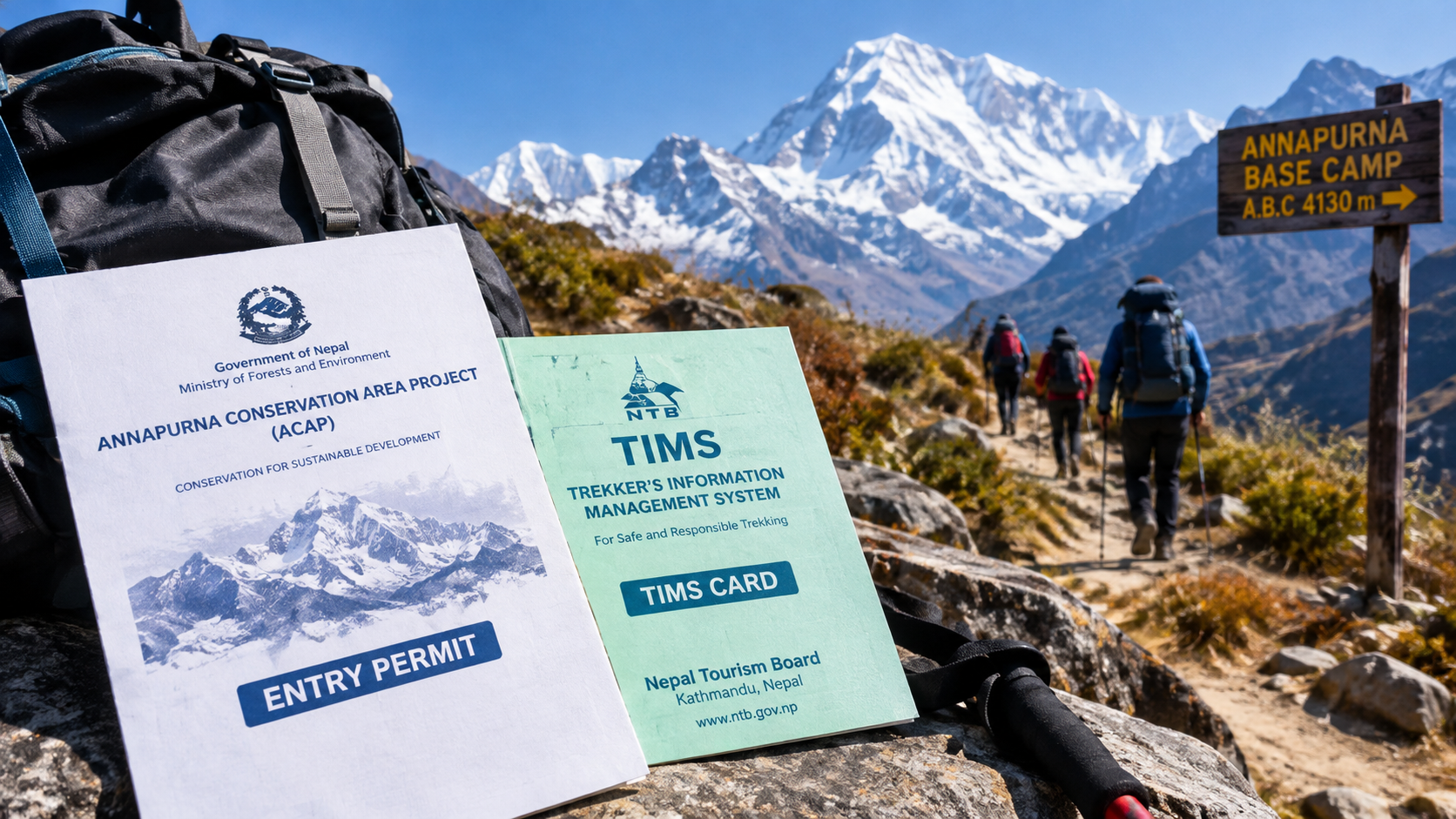
Three permits are required before you step onto the EBC trail, and having them sorted before you leave Kathmandu saves time and prevents checkpoint delays that can throw your whole schedule off. Your trekking agency handles the paperwork, but knowing what’s required means you can double-check everything is in order before departure.
Missing or incorrect documentation at the Monjo checkpoint at the Sagarmatha National Park entry can cause significant delays, and above Namche Bazaar, there are additional spot checks. Everything needs to be physically present, not on your phone.
- Sagarmatha National Park Permit required at Monjo checkpoint entry
- TIMS Card Trekkers’ Information Management System, mandatory for all trekkers
- Khumbu Pasang Lhamu Rural Municipality Fee: local conservation fee at the trailhead
- Keep physical copies of all permits; digital copies are not always accepted at checkpoints
- Confirm current permit fees before departure prices are updated periodically
Packing Essentials for a 14-Day EBC Trek
Overpacking is one of the most common and most painful mistakes first-time EBC trekkers make. Your porter carries a maximum weight, and every unnecessary kilo is a kilo that made someone else’s day harder for no good reason. The best 14-day Everest Base Camp itinerary spans altitudes from 2,610 m to 5,545 m with temperature swings of 25°C or more between daytime and overnight, so the key is a proper layering system, not volume.
Pack light, pack right, and test every piece of gear before you leave home. Boots in particular need to be properly broken in; blisters above Namche Bazaar with a week of trekking ahead of you are genuinely miserable and entirely avoidable.
- Base layer: moisture-wicking thermal, not cotton cotton kills at altitude
- Mid layer: quality fleece or softshell
- Outer layer: waterproof, windproof shell jacket and trousers
- Down jacket: heavyweight, rated to at least -15°C teahouse blankets above Namche are insufficient
- Sleeping bag: -15°C rated minimum
- Trekking poles: essential for the descents, especially below Tengboche Monastery
- Sunscreen and UV sunglasses: UV exposure above 4,000m is brutal and underestimated
Best Time to Trek the 14-Day Everest Base Camp Itinerary
Timing matters more on EBC than almost any other trek in the world, and choosing the wrong season can turn the best 14-day Everest Base Camp itinerary into a genuinely miserable experience. The two main trekking windows are spring (March to May) and autumn (September to November); everything else comes with real trade-offs that require honest assessment before booking.
The single most important factor is weather stability. Above Namche Bazaar and particularly above Tengboche Monastery, bad weather doesn’t just mean discomfort; it means trail closures, teahouse closures, and flight cancellations that cascade through the entire itinerary. Choosing a reliable weather window isn’t just about nice photographs; it’s a safety decision.
Spring Season (March–May) Peak Trekking Window
Spring is the most popular season for the best 14-day Everest Base Camp itinerary, and for good reason. The weather is stable, temperatures are moderate, and the rhododendron forests between Namche Bazaar and Tengboche Monastery bloom in brilliant red and pink. May is peak Everest climbing season, meaning you’ll likely see active expedition teams at Base Camp, which adds a whole extraordinary layer of atmosphere to arriving there.
Book at least 3–4 months in advance for spring departures. Teahouses at Namche Bazaar, Dingboche, and Gorak Shep fill up fast, prices are higher, and the trails are busy. For most first-time trekkers, the trade-off is absolutely worth it; the conditions, the energy, and the overall experience in spring are hard to beat.
Autumn Season (September–November) Crystal-Clear Skies
Post-monsoon autumn offers arguably the clearest mountain views of the year. The air is freshly washed, visibility is exceptional, and the photography above Namche Bazaar and from Kala Patthar is outstanding. Temperatures are cooler than in spring, particularly above Lobuche and Gorak Shep at night, but manageable with the right gear.
October is the sweet spot: dry, clear skies, and slightly less crowded than May. November brings colder temperatures above Pheriche and Dingboche but fewer trekkers, which some people genuinely prefer. Either month works well for the best 14-day Everest Base Camp; just pack one extra warm layer compared to spring.
Off-Season Trekking: Risks and Rewards
Winter (December to February) and monsoon (June to August) trekking on the EBC route is possible, but the risks are real and require honest acknowledgment. Many teahouses above Tengboche Monastery close in winter. Monsoon trails above Phakding are slippery, and visibility is consistently poor. Snow can block sections of the trail above Lobuche without warning, and helicopter evacuation is more complex in both seasons.
That said, off-season trekkers frequently report a quality of solitude above Namche Bazaar that’s genuinely impossible to find in peak season. If you have experience, a flexible itinerary, and an expert local guide, the rewards are real. Wilder Way Trekking can help you assess whether off-season EBC is right for your experience level and timeframe.
Why Choose Wilder Way Trekking for Your EBC Adventure?
There are dozens of trekking agencies offering EBC, and at a glance, many of them look similar. The difference, at 5,000 meters above sea level in deteriorating weather with a team you’re depending on completely, is not a small one. Wilder Way Trekking is a government of Nepal-registered agency (Reg. No. 359458/81/82) run by people who actually live and trek in these mountains, not a booking platform operated from a city office.
Our guides are TIMS-certified, experienced in altitude medicine response, and carry the kind of practical trail knowledge that no guidebook contains. We offer private and group departures for the best 14-day Everest Base Campitinerary with flexible scheduling, fair porter wages, and genuine accountability to the Sherpa communities along the route. When you trek with Wilder Way, you’re with people who consider these mountains home, and that makes every difference when it matters most.
Frequently Asked Questions
Is 14 Days Enough for Everest Base Camp?
Yes, 14 days is enough and the ideal duration for most trekkers. It includes two acclimatization days at Namche Bazaar and Dingboche, a buffer day for Lukla flight delays, and enough time to reach both Everest Base Camp and Kala Patthar comfortably. Shorter itineraries are possible but carry a much higher risk of altitude sickness.
How Difficult Is the Everest Base Camp Trek?
EBC is challenging but achievable for any fit, healthy adult. No technical climbing skills are required the trails are well-marked and non-technical throughout. The real challenge is altitude, not terrain. If you can hike 5–6 hours on consecutive days with a daypack, you have the fitness needed.
What Is the Best Time to Trek Everest Base Camp?
Spring (March–May) and autumn (September–November) are the best seasons. October is widely considered the single best month, with dry skies, crystal-clear views from Kala Patthar, and slightly fewer crowds than May. Avoid monsoon (June–August) and winter (December–February) unless you have significant trekking experience.
How Much Does the Everest Base Camp Trek Cost?
A guided 14-day EBC trek typically costs between $1,200 and $2,500 USD. This usually covers guide fees, porter fees, teahouse accommodation, and permits. Budget separately for international flights, travel insurance, personal gear, and guide and porter tips, which are 10–15% of the total trek cost.
Do I Need a Guide for the Everest Base Camp Trek?
A guide is not legally required but is strongly recommended. A good local guide manages your acclimatization pace, spots early altitude sickness symptoms, and navigates teahouse bookings in peak season. Beyond safety, a guide makes the entire experience richer, explaining the significance of places like Tengboche Monastery and Thokla Pass along the way.
What Permits Do I Need for Everest Base Camp?
Three permits are required: the Sagarmatha National Park Permit, the TIMS Card, and the Khumbu Pasang Lhamu Rural Municipality Fee. All three are checked at various points along the trail. If trekking with Wilder Way Trekking, all permits are arranged before you leave Kathmandu. Always carry physical versions; digital versions are not always accepted.
How Do I Prevent Altitude Sickness on the EBC Trek?
Follow a proper acclimatization schedule; it’s exactly what the best 14-day Everest Base Camp itinerary is built around. Drink 3–4 liters of water daily, avoid alcohol above Namche Bazaar, walk slowly, and never skip the rest days at Dingboche and Namche. If symptoms worsen despite these measures, descend immediately.
What Should I Pack for the Everest Base Camp Trek?
Pack light and focus on layering. The essentials are a down jacket rated to -15°C, a sleeping bag of the same rating, a waterproof shell jacket and trousers, moisture-wicking base layers, broken-in trekking boots, trekking poles, UV sunglasses, and high-SPF sunscreen. A pulse oximeter for monitoring blood oxygen above Dingboche and Pheriche is a small but genuinely useful addition.
Leave a comment: