
- 10 Views
- 14 Min Read
- (0) Comment
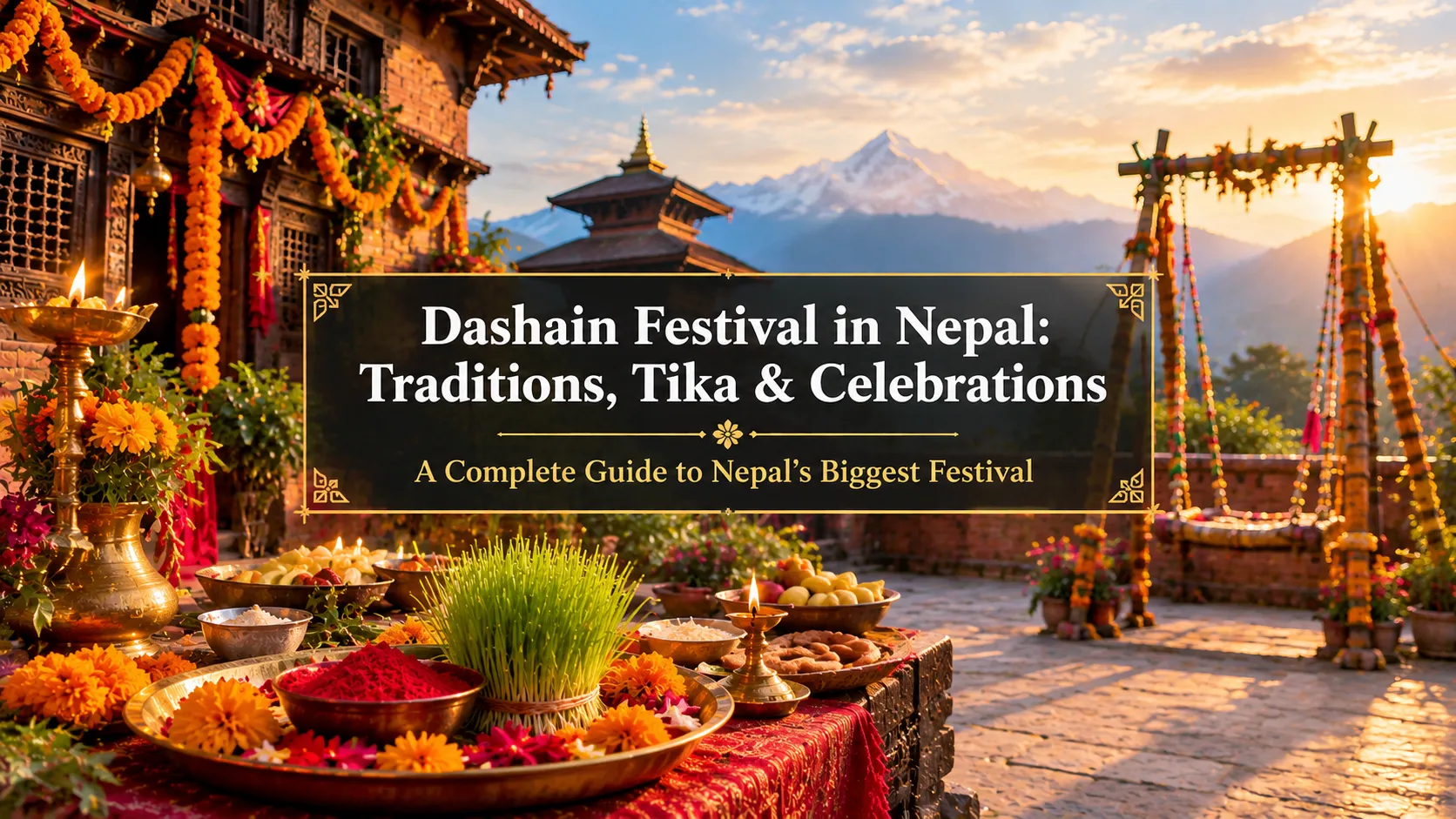
Dashain in Nepal is the country’s biggest and most widely celebrated Hindu festival, bringing families together for religious rituals, tika, jamara, feasting, blessings, travel, and cultural celebrations. The festival honors the victory of good over evil and is closely associated with Goddess Durga, family gatherings, and renewal.
For visitors, Dashain offers a deeper look at Nepali culture beyond temples and mountain trails. Cities become quieter as people travel home, families gather across generations, and traditional customs become especially visible. This guide explains the meaning, traditions, 10 days, tika, jamara, food, regional customs, travel considerations, and cultural importance of Dashain in Nepal.
What Is Dashain?
Dashain is Nepal’s most important Hindu festival and a major annual celebration centered on family, religious worship, blessings, and the victory of good over evil. It is traditionally associated with Goddess Durga and her victory over the buffalo demon Mahishasura. The festival is celebrated across Nepal and has become an important cultural occasion for many Nepali communities regardless of where they live.
Dashain normally spans 15 days, although the most significant rituals and public celebrations are concentrated around several key days. The festival begins with Ghatasthapana and reaches its main family celebration on Vijaya Dashami, when elders place tika and jamara on younger relatives. For many Nepalis, Dashain is also a time to return to their ancestral homes and reconnect with family.
Why Do Nepali People Celebrate Dashain?
Nepali people celebrate Dashain primarily to commemorate the victory of good over evil and to worship Goddess Durga, who represents strength, protection, and divine power. The religious traditions are connected with stories from Hindu mythology, particularly the victory of Durga over Mahishasura.
The festival also has a strong social and family dimension. People return to their hometowns, visit relatives, receive blessings from elders, prepare special meals, clean their homes, and exchange good wishes. These customs make Dashain much more than a religious festival. It is a period of family reunion, renewal, generosity, and cultural continuity.
Religious meaning of Dashain
The religious meaning of Dashain is closely connected with Shakti, the divine feminine power represented by Goddess Durga. Worship during the festival reflects ideas of protection, courage, victory, and the triumph of righteousness over destructive forces.
Important religious elements include:
- Worship of Goddess Durga
- Ghatasthapana and the establishment of the sacred kalash
- Growing jamara
- Daily worship during the festival period
- Animal sacrifice in some communities
- Receiving tika and blessings on Vijaya Dashami
- Visiting temples and sacred sites
- Family prayers and religious observances
Cultural meaning of Dashain
Dashain is equally important as a cultural tradition. Families living in cities often travel to their ancestral villages, sometimes making the journey several days before the main tika celebration.
The festival provides an opportunity to:
- Reunite with family members
- Visit parents, grandparents, and relatives
- Receive blessings from elders
- Share traditional food
- Wear new clothes
- Give gifts and money to younger relatives
- Play traditional games
- Maintain family traditions
- Strengthen community relationships
How Is Dashain Celebrated in Nepal?
Dashain is celebrated through a combination of religious rituals, family gatherings, traditional food, travel, worship, blessings, and community activities. The exact customs vary between ethnic groups, regions, families, and religious traditions, but the central themes remain family, worship, blessings, and the victory of good over evil.
The most visible celebration occurs around Vijaya Dashami, when people visit elders to receive tika and jamara. Homes are cleaned and decorated, families prepare special meals, and people often wear new clothes. Major cities can become unusually quiet during the main festival because large numbers of residents travel to their hometowns.
What Are the 10 Days of Dashain?
The first 10 days of Dashain contain some of the festival’s most important religious and cultural observances. Although Dashain continues beyond these days, the period from Ghatasthapana to Vijaya Dashami forms the core of the celebration.
| Day | Name | Main significance |
| Day 1 | Ghatasthapana | Sacred kalash is established and jamara seeds are planted |
| Day 2 | Dwitiya | Daily worship continues |
| Day 3 | Tritiya | Household religious observances continue |
| Day 4 | Chaturthi | Worship and preparation continue |
| Day 5 | Panchami | Religious observances continue |
| Day 6 | Shashthi | Preparations for major rituals continue |
| Day 7 | Phulpati | Sacred flowers and ritual objects are brought into homes |
| Day 8 | Maha Ashtami | Major worship of Goddess Durga takes place |
| Day 9 | Maha Navami | Worship and rituals continue; vehicles and tools may also be blessed |
| Day 10 | Vijaya Dashami | Elders give tika, jamara, blessings, and gifts |
The importance and specific practices of individual days can vary by family and community. Phulpati, Maha Ashtami, Maha Navami, and Vijaya Dashami are among the most widely recognized days of the festival.
What Is Dashain Tika?
Dashain tika is a mixture traditionally made from rice, yogurt, and vermilion, although preparation can vary among families and communities. During Vijaya Dashami, elders place tika on the foreheads of younger family members and offer blessings for health, prosperity, happiness, and success.
Receiving tika is one of the most recognizable Dashain traditions in Nepal. Younger relatives commonly visit parents, grandparents, and other senior family members throughout the festival. Along with tika and jamara, elders may give dakshina, traditionally money offered as a blessing.
What Is Jamara in Dashain?
Jamara is the sacred grass grown from seeds planted during Ghatasthapana at the beginning of Dashain. Traditionally, barley and other grains may be used, and the seedlings are grown in a protected, relatively dark place until they develop into the characteristic yellow-green shoots.
On Vijaya Dashami, jamara is placed together with tika on the heads of family members receiving blessings. Because it grows during the festival, jamara has become an important symbol of life, prosperity, renewal, and auspiciousness.
Which God or Goddess Is Worshipped During Dashain?
Goddess Durga is the principal deity associated with Dashain. Different manifestations of the goddess are worshipped during the festival, particularly during the important days of Navaratri.
The worship reflects the belief in divine strength overcoming evil and destructive forces. Across Nepal, religious practices differ according to local traditions, family customs, and communities.
Dashain worship may include:
- Goddess Durga
- Different forms of Shakti
- Family deities
- Household shrines
- Sacred kalash
- Temples dedicated to Hindu deities
The festival therefore combines widely shared Hindu traditions with local religious practices.
Is Dashain the Same as Dussehra?
Dashain and Dussehra are closely related festivals, but they are not identical in the way they are celebrated across South Asia. Both are connected with the victory of good over evil and Hindu religious traditions, but their rituals, names, cultural expressions, and regional practices differ.
| Feature | Dashain in Nepal | Dussehra in India |
| Main region | Nepal | India and other regions |
| Major theme | Victory of good over evil | Victory of good over evil |
| Important deity | Goddess Durga | Varies by region |
| Family tika tradition | Central to Dashain | Varies |
| Jamara | Important Dashain symbol | Varies |
| Major family reunion | Very prominent | Varies |
| Local customs | Strong regional variation | Strong regional variation |
In Nepal, Dashain has developed into a particularly important combination of religious observance, family reunion, cultural tradition, and national celebration.
Is Dashain Part of Navratri?
Yes. Dashain is closely connected with the Hindu Navratri tradition, particularly the nine-day period of worship associated with Goddess Durga. The relationship is most visible through the religious observances leading up to Vijaya Dashami.
However, Dashain in Nepal extends beyond the nine-day Navratri framework. Nepali Dashain includes distinctive traditions such as Ghatasthapana, Phulpati, tika, jamara, family gatherings, and blessings from elders.
Dashain Traditions and Customs in Nepal
Dashain traditions differ between communities and regions, but several practices are widely recognized throughout Nepal. These customs help explain why the festival remains such an important part of Nepali cultural life.
Family reunions
Family reunion is one of the defining features of Dashain. Nepalis living away from their hometowns often travel home before the main celebration.
For many families, this annual journey is as important as the religious rituals themselves. Parents, children, grandparents, siblings, and extended relatives gather under one roof, often after months or even years apart.
Receiving tika and jamara
On Vijaya Dashami, family members visit elders to receive tika, jamara, blessings, and sometimes dakshina. The practice reinforces relationships between generations and gives younger relatives an opportunity to receive guidance and goodwill from elders.
New clothes
Wearing new clothes is a popular Dashain custom, particularly among children. Families may purchase new clothing before the festival and wear it during family visits and tika celebrations.
Playing games
Traditional games and recreational activities are common during Dashain. Children may fly kites, play cards, swing on traditional bamboo swings, and participate in neighborhood activities.
Cleaning the home
Homes are commonly cleaned and prepared before the festival. This reflects the broader idea of starting the festival with a renewed and positive environment.
Visiting relatives
Dashain is a major period for visiting parents, grandparents, relatives, neighbors, and family friends. These visits strengthen social relationships and maintain cultural traditions.
What Do People Eat During Dashain?
Food is an important part of Dashain celebrations, with families preparing richer and more festive meals than during ordinary days. Recipes vary considerably by household, ethnicity, and region.
Common Dashain foods can include:
- Mutton and other meat dishes
- Sel roti
- Rice
- Dal
- Pickles
- Vegetables
- Yogurt
- Fruits
- Sweets
- Traditional homemade snacks
Sel roti, a ring-shaped rice bread, is particularly associated with festivals and special occasions in Nepal. Food traditions are not identical throughout the country, so visitors should expect considerable regional and family variation.
Dashain in Different Parts of Nepal
Dashain is celebrated throughout Nepal, but the experience differs according to geography, ethnicity, religion, and local traditions. Kathmandu Valley combines household rituals with temple visits and urban celebrations, while villages may place greater emphasis on ancestral homes and extended family gatherings.
The Terai, hills, and Himalayan regions also have their own cultural expressions. If you are interested in combining cultural experiences with mountain travel, Nepal’s Himalayan culture and traditional mountain communities can provide useful background before choosing a route.
Why Is Dashain Important to Nepali Culture?
Dashain is important because it connects religious belief with family relationships, community identity, tradition, and cultural continuity. It is one of the few times each year when large numbers of Nepalis make a deliberate effort to return home and spend extended time with their families.
The festival also demonstrates the diversity of Nepal. Although Dashain has strong Hindu roots, its social and cultural importance extends across many communities. Traditional foods, family rituals, music, clothing, religious practices, and regional customs all contribute to the broader cultural experience of the festival.
For a broader understanding of how culture, heritage, adventure, and responsible travel intersect in Nepal, see Nepal’s cultural and responsible travel experiences.
What Happens During Dashain in Nepal?
Dashain transforms daily life in Nepal, particularly during the days surrounding Vijaya Dashami. Roads and transport services become busy as people travel home, while many offices and businesses close or operate on reduced schedules during public holidays.
| Activity | What visitors may experience |
| Family travel | Large numbers of people returning to hometowns |
| Tika | Elders blessing younger family members |
| Jamara | Sacred seedlings placed with tika |
| Temple visits | Increased religious activity |
| Family meals | Special traditional dishes |
| New clothes | Festive clothing, especially among children |
| Kite flying | Popular recreational activity |
| Bamboo swings | Traditional festival recreation |
| Shopping | Increased activity before major celebration days |
| Travel | Busy roads and transport before and after major holidays |
For travelers, these changes are important because transport, accommodation, opening hours, and access to some services may differ from normal periods.
Dashain Travel in Nepal
Traveling in Nepal during Dashain can be rewarding because visitors can observe one of the country’s most important cultural traditions. At the same time, the festival creates practical travel challenges because large numbers of Nepalis travel between Kathmandu, Pokhara, the Terai, and their hometowns.
If you are planning a wider Nepal itinerary around cultural experiences, planning a trip to Nepal around local festivals and cultural experiences is a useful starting point. It covers major destinations and practical considerations for combining culture, nature, and adventure.
Travelers should consider:
- Booking domestic transport early
- Allowing extra road travel time
- Confirming accommodation before arrival
- Checking opening hours
- Respecting private family celebrations
- Dressing appropriately around temples
- Asking permission before photographing rituals
- Expecting changes to normal business schedules
Dashain can therefore be an excellent cultural period for travel, but it requires more flexibility than an ordinary travel week.
What Should Visitors Know About Dashain in Nepal?
Visitors should understand that Dashain is first and foremost a family and religious festival rather than a tourist performance. Travelers can observe public aspects of the celebration, but private family rituals should be approached respectfully.
A local guide can also help explain customs, religious sites, etiquette, and community practices that may not be obvious to first-time visitors. For travelers interested in understanding these traditions while exploring Nepal, local knowledge of Nepal’s customs and festivals can make cultural experiences more meaningful.
Practical etiquette for visitors
- Ask before photographing people during religious rituals.
- Dress respectfully at temples and shrines.
- Do not interrupt family tika ceremonies.
- Follow temple rules regarding shoes and photography.
- Avoid touching religious objects without permission.
- Respect different religious and cultural practices.
- Be patient when transport becomes crowded.
- Remember that not every Dashain tradition is practiced identically across Nepal.
How to Wish Someone Happy Dashain
The most common English greeting is simply “Happy Dashain” or “Happy Dashain to you and your family.”
You may also hear Nepali greetings such as:
- “Dashain ko subhakamana.”
- “Bada Dashain ko hardik mangalmaya subhakamana.”
These expressions convey good wishes for happiness, health, prosperity, and a successful festival.
If you are visiting Nepal during Dashain, using a simple local greeting is a respectful way to acknowledge the importance of the festival.
Dashain Symbols and Their Meanings
Dashain includes several objects and traditions that carry religious or cultural meaning. Their exact interpretation can vary between communities, but some symbols are widely recognized.
| Symbol | Meaning or association |
| Tika | Blessing, auspiciousness, and goodwill |
| Jamara | Life, prosperity, renewal, and auspiciousness |
| Kalash | Sacred presence and ritual purity |
| Durga | Divine strength and protection |
| Phulpati | Important sacred offerings and festival observance |
| New clothes | Celebration and renewal |
| Bamboo swing | Traditional recreation and community celebration |
| Kite | Festive recreation and childhood memories |
These symbols help make Dashain recognizable even to visitors who are unfamiliar with the religious background of the festival.
Experience Nepal During Dashain
Experiencing Nepal during Dashain gives travelers an opportunity to see a side of the country that cannot be understood only through trekking routes and mountain landscapes. The festival reveals how family relationships, religious traditions, food, community, and regional identity are woven into everyday Nepali life.
Travelers who want to combine cultural discovery with Himalayan landscapes can also explore regions such as Langtang, where mountain scenery, Tamang heritage, Buddhist traditions, villages, and protected landscapes come together. Nepal’s Himalayan culture and traditional mountain communitiesis a useful resource when considering a culturally focused mountain itinerary.
Experience the Cultural Side of Nepal
Dashain is more than a festival on the calendar. It is a period when families return home, elders bless younger generations, traditional foods are prepared, religious rituals are observed, and communities renew relationships that connect generations.
For visitors, the best way to experience Dashain is with patience and respect. Observe rather than interrupt, ask before photographing, and remember that many of the festival’s most meaningful moments happen inside family homes rather than at tourist attractions.
Travelers who want cultural context throughout a Nepal journey can benefit from working with people who understand local customs, communities, religious practices, and regional traditions. Wilderway Trekking & Expedition works with local guides and travel professionals who focus on authentic experiences, cultural understanding, and responsible travel. Meet the local Nepal trekking and Himalayan experts.
Dashain ultimately offers a reminder that Nepal’s greatest cultural experiences are often found in ordinary moments: a family gathering around a meal, an elder placing tika on a child’s forehead, jamara being carefully prepared, or relatives traveling long distances simply to be together.
Dashain Festival FAQ
What is Dashain in Nepal?
Dashain is Nepal’s largest Hindu festival and one of the country’s most important cultural celebrations. It is associated with Goddess Durga, the victory of good over evil, family reunions, tika, jamara, blessings, traditional food, and religious rituals.
Why is Dashain celebrated in Nepal?
Dashain is celebrated to commemorate the victory of good over evil and to honor Goddess Durga and related Hindu traditions. It is also an important period for family reunions, blessings, cultural customs, and renewal.
How long does Dashain last?
Dashain traditionally spans 15 days, beginning with Ghatasthapana and continuing through the later festival observances. The most prominent family celebration occurs on Vijaya Dashami.
What is the main day of Dashain?
Vijaya Dashami is the principal family celebration of Dashain. On this day, people commonly visit elders to receive tika, jamara, blessings, and sometimes dakshina.
What is jamara?
Jamara is sacred grass grown from seeds planted during Ghatasthapana. The seedlings are traditionally grown during the festival and placed with tika on Vijaya Dashami.
Do people travel during Dashain?
Yes. Dashain is one of Nepal’s busiest periods for domestic family travel. Many people leave Kathmandu and other cities to return to their ancestral homes.
Is Nepal open to tourists during Dashain?
Yes, tourists can travel in Nepal during Dashain, but transport schedules, business hours, accommodation availability, and local services may differ from normal periods.