- 30 Views
- 18 Min Read
- (0) Comment
Trekking in Nepal can require several different permits or entry fees depending on your route. The main requirements are the TIMS Card, protected-area entry fees for national parks or conservation areas, and special trekking permits for restricted areas. The exact combination depends on the trekking region, route, season and whether the trail enters a restricted zone.
Nepal Trekking Permits at a Glance
| Requirement | What it is | Where it applies |
| TIMS Card | Trekker registration and safety-management document | Designated trekking routes |
| National Park Entry | Protected-area entry fee | National parks |
| Conservation Area Entry | Protected-area entry fee | Conservation areas |
| Restricted Area Permit | Special permit for controlled trekking zones | Government-designated restricted areas |
| Mountaineering Permit | Climbing authorization | Mountaineering expeditions |
You do not automatically need every document listed above. A trek in a national park may require TIMS plus a park entry fee, while a restricted-area trek can require TIMS, a conservation-area fee and a separate restricted-area permit. Mountaineering permits are a separate category from ordinary trekking permits.
The Nepal Tourism Board separates these systems because they serve different purposes. TIMS records trekker information for safety and security, protected-area fees provide access to designated conservation areas, and restricted-area permits control access to government-designated zones.
What Are Nepal Trekking Permits?
“Nepal trekking permits” is a broad search term that covers several types of documentation rather than one universal permit.
For most trekkers, the important distinction is between TIMS, protected-area entry fees and restricted-area trekking permits.Treating all three as the same document can lead to incorrect cost estimates or problems at checkpoints.
TIMS Card
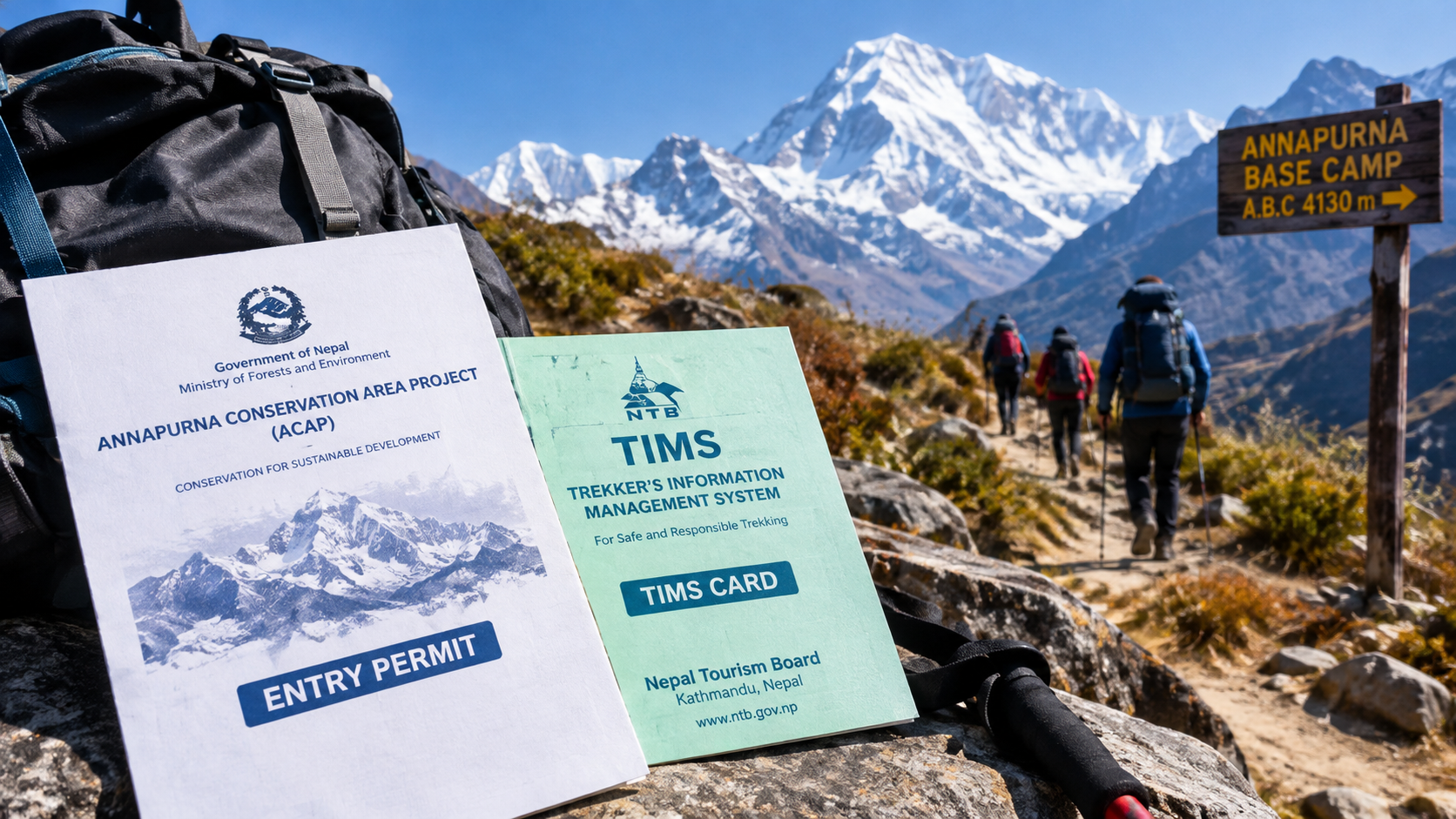
The Trekkers’ Information Management System (TIMS) is designed to register trekkers and support safety, security and emergency coordination.
Under Nepal’s revised TIMS provision, the Nepal Tourism Board lists numerous trekking routes where trekkers must be accompanied by a licensed guide and carry an agency-issued TIMS Card. The current NTB information lists the TIMS charge as NPR 1,000 for SAARC applicants and NPR 2,000 for other applicants.
Protected-Area Entry Fee
A protected-area entry fee applies when a trek enters a national park or conservation area.
Examples include:
- Sagarmatha National Park
- Langtang National Park
- Shey-Phoksundo National Park
- Annapurna Conservation Area
- Manaslu Conservation Area
- Kanchenjunga Conservation Area
- Gaurishankar Conservation Area
- Api Nampa Conservation Area
The fee is separate from TIMS.
Restricted Area Trekking Permit
A restricted-area trekking permit is different from TIMS and protected-area entry.
These permits apply to specially controlled areas such as Upper Mustang, Upper Dolpa, Manaslu’s restricted zone, Tsum Valley, Nar Phu and several other designated regions.
The Department of Immigration administers restricted-area trekking permits. Nepal Tourism Board guidance also states that trekkers must carry the permit during the trek and produce it to immigration or police officials when requested.
What Permits Do You Need for Trekking in Nepal?
The answer depends primarily on where you are trekking, not simply how many days you are walking.
A useful way to determine your requirements is:
Route → protected area → restricted zone → TIMS requirement → guide requirement → seasonal fees
For example, an ordinary trek through a national park can have a different permit structure from a trek entering a restricted border region.
TIMS Card
The current Nepal Tourism Board TIMS guidance states that the revised provision applies to specified trekking regions and routes. Its listed routes include Everest Base Camp, Gokyo, Three Passes, Kanchenjunga Base Camp, Makalu Base Camp, Gosaikunda, Helambu and several other routes.
TIMS is therefore best understood as a route-specific trekking registration requirement, not as a universal substitute for every other permit.
National Park Entry Permit
If your route enters a national park, you normally need to pay the applicable protected-area entry fee.
Important trekking parks include:
- Sagarmatha National Park
- Langtang National Park
- Shey-Phoksundo National Park
- Makalu-Barun National Park
- Rara National Park
Conservation Area Entry
Conservation areas have their own entry fees.
Major trekking conservation areas include:
- Annapurna Conservation Area
- Manaslu Conservation Area
- Kanchenjunga Conservation Area
- Gaurishankar Conservation Area
- Api Nampa Conservation Area
Restricted-Area Permit
If your route enters a government-designated restricted area, an additional trekking permit is required.
This is especially important for:
- Upper Mustang
- Upper Dolpa
- Manaslu restricted area
- Tsum Valley
- Nar Phu
- Humla
- parts of Rasuwa
- parts of Manang
- selected border and remote mountain regions
Nepal Trekking Permit Fees in 2026
Permit prices can change through government decisions, seasonal rules or administrative updates. For that reason, the fee should always be checked against the latest official authority before departure.
As checked on 15 September 2026, the Department of Immigration’s current trekking-permit page lists restricted-area fees ranging from approximately USD 20 per week to USD 500 for the first 10 days, depending on the region and permit category.
The current Immigration information includes examples such as:
| Restricted area | Current Immigration-listed fee |
| Upper Mustang | USD 50/person/day |
| Upper Dolpa | USD 500/person for first 10 days, then USD 50/day |
| Manaslu | Seasonal pricing |
| Humla | USD 50/person/week |
| Taplejung | USD 20/week for first 4 weeks |
| Lower Dolpa | USD 20/person/week |
| Dolakha | USD 20/person/week |
| Tsum Valley | Seasonal pricing |
| Sankhuwasabha | USD 20/week for first 4 weeks |
| Solukhumbu restricted area | USD 20/week for first 4 weeks |
| Rasuwa | USD 20/person/week |
| Manang | Seasonal pricing |
| Bajhang | USD 90/week |
| Mugu | USD 100/person/week |
| Darchula | USD 90/person/week |
Important: These are restricted-area permit fees only. They do not necessarily include TIMS, conservation-area entry, national-park entry or local fees.
There are also discrepancies between some older NTB-published material and the current Department of Immigration information. For a high-trust article, the latest Immigration schedule should be treated as the operational reference for restricted-area fees, while NTB remains an important source for the broader trekking-permit framework.
Restricted Area Trekking Permit Fees
A restricted-area permit is not the same thing as a TIMS Card or a national park/conservation-area entry fee.This distinction is one of the most important concepts for anyone researching Nepal trekking permits.
Upper Mustang
The Department of Immigration currently lists USD 50 per person per day for the Upper Mustang restricted area.
Upper Mustang also falls within the Annapurna Conservation Area, so the restricted permit should not be treated as the complete permit budget.
Upper Dolpa
Upper Dolpa has a premium restricted-area permit structure. The current Immigration information lists USD 500 per person for the first 10 days, followed by USD 50 per day.Additional protected-area requirements may apply.
Manaslu
Manaslu has a seasonal restricted-area permit structure.The fee changes according to the trekking season, so travelers should check the current Immigration schedule rather than relying on an old blog post or itinerary PDF.
Tsum Valley
Tsum Valley is another restricted area inside the Manaslu region.A Tsum Valley itinerary can therefore require more than the standard Manaslu conservation-area entry and TIMS arrangements.
Nar Phu
Nar Phu is within the restricted portion of the Annapurna region. Trekkers should distinguish the restricted-area permit from the standard Annapurna Conservation Area entry requirement.
Nepal Trekking Permits by Popular Trek
The following table provides a practical starting point.
| Trek | TIMS | Protected-area requirement | Restricted permit |
| Everest Base Camp | Required under current listed route rules | Sagarmatha National Park | Route-dependent |
| Annapurna Circuit | Route-dependent/current TIMS rules | ACAP | Route-dependent |
| Annapurna Base Camp | Current TIMS rules apply | ACAP | Normally no restricted permit |
| Manaslu Circuit | Required | MCAP | Yes |
| Tsum Valley | Required | MCAP | Yes |
| Upper Mustang | Required where applicable | ACAP | Yes |
| Langtang Valley | Required under listed routes | Langtang National Park | Normally no restricted permit |
| Gosaikunda | Listed under current TIMS rules | Langtang National Park | Route-dependent |
| Tamang Heritage | Listed under current TIMS rules | Langtang National Park | Route-dependent |
| Kanchenjunga | Required | KCA | Route-dependent |
| Upper Dolpo | Required | Shey-Phoksundo National Park | Yes |
| Lower Dolpo | Required | Shey-Phoksundo National Park | Yes |
This table should be treated as a planning guide rather than a replacement for route-specific permit verification.
Annapurna Region Trekking Permits
The Annapurna region contains both standard trekking routes and restricted-area routes, so permit requirements depend on the itinerary.
Annapurna Circuit Permit Requirements
A standard Annapurna Circuit itinerary generally involves:
- TIMS under applicable current rules
- Annapurna Conservation Area entry
- Route-specific local requirements where applicable
If the itinerary enters Nar Phu, the permit structure changes because Nar Phu is a restricted area.
The same principle applies when a trek adds specialized high-altitude crossings or routes that enter controlled zones.
Annapurna Base Camp Permit Requirements
Annapurna Base Camp lies within the Annapurna Conservation Area.
Trekkers should therefore distinguish between:
- TIMS
- ACAP entry
- any current route-specific requirements
The standard ABC itinerary does not normally involve the same restricted-area permit structure as Nar Phu or Upper Mustang.
Tilicho Lake and Tilicho Pass
Adding Tilicho Lake to the Annapurna Circuit does not automatically mean the trek has entered a restricted area.
This is an important distinction for trekkers planning an Annapurna Circuit with Tilicho Lake.
A standard Tilicho Lake detour should not be confused with routes involving Mesokanto Pass or other restricted/high-altitude itineraries that may have different requirements.
Everest Region Trekking Permits
The Everest region is one of Nepal’s most popular trekking areas, but popularity does not remove the need to follow current permit rules.
Everest Base Camp
The current NTB TIMS route list includes Everest Base Camp among the routes covered by the guide and TIMS provision.
An EBC trek can therefore involve:
- TIMS
- Sagarmatha National Park entry
- applicable local or municipal requirements
- licensed guide arrangements under current rules
Gokyo Trek
Gokyo is also included in the current NTB TIMS route list.
The trek enters the Sagarmatha National Park area, so protected-area entry requirements also apply.
Everest Three Passes
The Three Passes Trek is listed by NTB under the current guide/TIMS requirements.
Because this itinerary is longer and crosses several high mountain passes, trekkers should verify the complete route and permit package before departure.
Mera Peak and Climbing Routes
A trekking permit should not automatically be confused with a mountaineering permit.
Once an itinerary involves climbing a designated peak, additional climbing authorization and royalty requirements may apply.
Manaslu Region Trekking Permits
Manaslu is one of Nepal’s clearest examples of why the phrase “Nepal trekking permit” can be misleading.
Manaslu Circuit
A Manaslu Circuit itinerary can involve:
- TIMS
- Manaslu Conservation Area entry
- restricted-area permit
- guide and agency requirements
- seasonal permit pricing
- applicable local requirements
The restricted-area permit is particularly important because the Manaslu region is subject to controlled access.
Tsum Valley
Tsum Valley has its own restricted-area requirements in addition to the broader Manaslu permit structure.
A combined Manaslu + Tsum Valley itinerary therefore needs to be calculated according to the exact route and dates.
Mustang, Dolpo and Humla Permits
Remote trans-Himalayan regions often have more complex permit structures.
Upper Mustang
Upper Mustang requires a restricted-area permit as well as the applicable conservation-area entry.
The current Immigration schedule lists USD 50 per person per day for the restricted zone.
Lower Mustang
Lower Mustang should not automatically be treated as Upper Mustang.
The restricted-area rules associated with Upper Mustang do not simply apply to every trekking route in Lower Mustang.
Upper Dolpo
Upper Dolpo combines restricted-area controls with protected-area requirements associated with Shey-Phoksundo National Park.
The current Immigration fee structure is significantly different from the standard fees associated with ordinary trekking routes.
Lower Dolpo
Lower Dolpo also has restricted-area requirements, but its permit structure differs from Upper Dolpo.
Humla and Limi Valley
Humla’s remote border geography means that route-specific restricted-area documentation can be important.
Trekkers should confirm:
- restricted-area permit
- TIMS
- applicable protected-area entry
- agency and guide requirements
- exact itinerary
- current permit fee
Langtang, Gosaikunda and Tamang Heritage Permits
The Langtang region is especially important for permit planning because several popular routes overlap the same broader trekking area.
These include:
- Langtang Valley
- Gosaikunda
- Tamang Heritage
- combined Langtang-Gosaikunda routes
The current NTB TIMS information specifically lists Gosaikunda and other Langtang-area routes among routes covered by the current guide/TIMS provision.
Trekkers should also account for Langtang National Park entry.
For Gosaikunda, route planning matters because alternative approaches can cross different jurisdictions or route segments.
How Much Does a Nepal Trekking Permit Cost?
There is no single universal Nepal trekking permit price.
Your total permit budget can consist of several separate charges:
- TIMS
- National Park entry
- Conservation Area entry
- Restricted-area permit
- Local government or municipality fees where applicable
- Mountaineering or climbing permits where applicable
For example, the permit budget for Everest Base Camp is not calculated in exactly the same way as Manaslu, Upper Mustang or Upper Dolpo.
This is why articles that advertise one “Nepal trekking permit cost” without identifying the route can be misleading.
Example Permit Cost Structure
Everest Base Camp
Budget for the applicable TIMS requirement, protected-area entry and any current local requirement.
Annapurna Circuit
Budget for applicable TIMS, Annapurna Conservation Area entry and any route-specific requirement.
Manaslu Circuit
Budget for TIMS, Manaslu Conservation Area entry and the seasonal restricted-area permit.
Upper Mustang
Budget for the restricted-area permit plus ACAP and applicable TIMS requirements.
Upper Dolpo
Budget for the premium restricted-area permit plus Shey-Phoksundo National Park and other applicable requirements.
Tsum Valley
Budget for TIMS, MCAP and the Tsum Valley restricted-area permit.
The important lesson is simple: calculate the complete permit package rather than searching for one universal trekking permit price.
How to Get a Trekking Permit in Nepal
The process depends on the type of permit.
Step 1: Choose Your Route
Start with the exact trekking itinerary rather than simply choosing a region.
For example, “Annapurna” is not enough information to determine whether you are doing ABC, the Circuit, Nar Phu or another route.
Step 2: Check Whether the Route Is Restricted
Identify whether any part of your itinerary enters a restricted zone.
This can significantly change the documentation and cost.
Step 3: Check TIMS Requirements
Confirm whether your route is covered by the current TIMS and licensed-guide provision.
Step 4: Check Protected-Area Fees
Identify every national park or conservation area crossed by the route.
Step 5: Use a Registered Trekking Agency Where Required
Restricted-area permits are generally processed through the authorized agency system.
Step 6: Submit the Required Details
Depending on the permit, documentation can include:
- passport details
- trekker information
- itinerary
- trekking dates
- agency information
- guide information
- photographs
- insurance documentation
- payment documentation
Step 7: Carry the Permit
Do not leave permit documentation at your hotel.
Restricted-area permits should be carried during the trek and produced to authorized officials when requested.
What Documents Are Required?
A practical permit checklist includes:
- Passport
- Passport details
- Passport-size photograph where required
- Trekking itinerary
- Route details
- Trekking dates
- Trekking agency information
- Guide information where applicable
- Emergency/contact information
- Insurance documentation where required
- Payment
Exact requirements vary according to the permit category.
Do You Need a Guide to Get a Nepal Trekking Permit?
For many major trekking routes, current rules require a licensed trekking guide and agency-issued TIMS Card.
The current NTB route list includes Everest Base Camp, Gokyo, Three Passes, Gosaikunda, Kanchenjunga Base Camp, Makalu Base Camp and other routes.
Restricted areas have additional agency and guide requirements.
However, it would be inaccurate to say that every trekking route in Nepal has exactly the same guide and permit rules. Requirements depend on the route and the current government provisions.
Nepal Trekking Permits vs TIMS vs National Park Entry
| Document | Main purpose | Authority | Applies to |
| TIMS | Trekker registration and safety | NTB / registered agency | Designated trekking routes |
| National Park Entry | Protected-area access | Protected-area authority | National parks |
| Conservation Area Entry | Protected-area access | Relevant conservation authority | Conservation areas |
| Restricted Area Permit | Controlled access | Department of Immigration | Restricted areas |
| Mountaineering Permit | Peak-climbing authorization | Relevant government authority | Mountaineering |
This distinction is essential when calculating trekking costs.
Can You Get Nepal Trekking Permits Without a Trekking Agency?
There is no single answer for every trek.
Standard trekking routes and restricted routes can have different administrative requirements.
Current NTB guidance states that specified routes require an agency-issued TIMS Card and licensed guide. Restricted-area permits are also administered through the authorized agency process.
Therefore, trekkers should not assume that a permit can always be purchased independently simply because the trek itself is popular.
Where Can You Get Trekking Permits in Nepal?
Permit services depend on the type of document.
Kathmandu
Kathmandu is the main administrative center for many trekking and restricted-area permit processes.
Pokhara
Pokhara is particularly important for Annapurna-region trekking and has trekking-related permit services.
Registered Trekking Agency
For routes requiring agency-issued TIMS or restricted-area documentation, working with a registered trekking company can simplify the process.
Online TIMS
The Nepal Tourism Board currently provides an online agency process for TIMS. Agencies enter trekker, guide and route information, complete payment and generate an electronic TIMS card with a QR code.
What Happens If You Trek Without the Required Permit?
Trekking without required documentation can create legal and practical problems.
Possible consequences include:
- problems at checkpoints
- inspection by immigration or police officials
- interruption of the itinerary
- inability to enter a restricted zone
- problems during route verification
- complications during emergency or rescue coordination
Avoid assuming that an old blog post or another trekker’s experience represents the current rules.
Do Nepal Trekking Permits Expire?
Permit validity depends on the permit type and the dates or duration stated on the document.
Restricted-area permits can have:
- weekly validity
- daily charges after an initial period
- seasonal pricing
- route-specific validity
Always check the dates printed on the permit and make sure they match your actual itinerary.
Nepal Trekking Permit Rules for Children
Children can be subject to different fee rules depending on the permit category.
For example, Nepal Tourism Board’s protected-area fee information identifies free entry for children below 10 years for the listed protected-area fees.
That does not mean every trekking document or restricted-area permit automatically follows the same exemption.
Families should therefore check the specific permit category before departure.
Do You Need a Permit for Short Treks in Nepal?
Trek duration does not automatically determine whether you need a permit.
A short trek can still enter a protected area and require an entry fee or fall under current TIMS requirements.
Examples include:
- Gosaikunda
- Poon Hill
- Everest View
- Langtang routes
- Shivapuri-area trekking
- cultural and heritage trails
The route and jurisdiction, rather than simply the number of trekking days, determine the applicable requirements.
Common Nepal Trekking Permit Mistakes
- Assuming TIMS is the only required document
- Confusing park fees with restricted-area permits
- Using outdated fee information
- Booking before checking the exact route
- Ignoring seasonal restricted-area pricing
- Assuming similar routes have identical requirements
- Forgetting guide requirements
- Entering a restricted zone without the correct permit
- Failing to carry permit documents
- Using passport information that does not match the permit application
The biggest mistake is relying on a fee table without checking its publication date.
Nepal Trekking Permit Checklist Before Leaving Kathmandu
Before starting your trek, confirm:
- ☐ Passport valid for travel
- ☐ Exact trekking route confirmed
- ☐ TIMS requirement confirmed
- ☐ National park entry confirmed
- ☐ Conservation-area entry confirmed
- ☐ Restricted-area permit confirmed if applicable
- ☐ Licensed guide arranged where required
- ☐ Permit dates checked
- ☐ Passport information matches documents
- ☐ Digital copies saved
- ☐ Emergency contacts available
- ☐ Travel insurance confirmed
- ☐ Current route conditions checked
Nepal Trekking Permits: Region-by-Region Quick Reference
| Region | TIMS | Protected Area | Restricted Permit |
| Everest | ✓ | Sagarmatha NP | Route-dependent |
| Annapurna | ✓ | ACAP | Route-dependent |
| Manaslu | ✓ | MCAP | ✓ |
| Langtang | ✓ | Langtang NP | Route-dependent |
| Mustang | ✓ | ACAP | ✓ in restricted areas |
| Dolpo | ✓ | Shey-Phoksundo NP | ✓ |
| Humla | ✓ | Route-dependent | ✓ |
| Kanchenjunga | ✓ | KCA | Route-dependent |
| Tsum | ✓ | MCAP | ✓ |
Always verify the exact route before departure because permit regulations, fees and guide requirements can change.
Plan Your Trek With the Right Permits
Planning a trek in Nepal starts with the route, not the permit.Once the itinerary is clear, the applicable TIMS, protected-area entry, restricted-area permit, guide and documentation requirements become much easier to identify.A registered local trekking company can help you verify the current requirements, prepare the documentation, arrange licensed guides where required and make sure the permit package matches your actual route and dates.
At Wilderway Trekking & Expedition, the practical approach is simple: choose the right trek first, verify the current rules, then build the logistics around them.Whether you are planning the Everest Base Camp Trek, Annapurna Circuit, Annapurna Base Camp, Manaslu Circuit, Gosaikunda, Langtang, Upper Mustang or a more remote Himalayan route, the permit requirements should be confirmed before leaving Kathmandu.Your permit is more than paperwork. It connects your trek with Nepal’s visitor-management, conservation and safety systems.
Plan the route carefully, verify the current requirements, and start your Himalayan journey with the right documents in place.
Frequently Asked Questions About Nepal Trekking Permits
Do I need a permit to trek in Nepal?
Most organized trekking routes involve some form of registration or protected-area access requirement. Depending on the route, this may include TIMS, national park or conservation-area entry, and a restricted-area permit. The exact combination depends on the trekking region and itinerary.
What is the cost of a trekking permit in Nepal?
There is no single Nepal trekking permit price. The total depends on the route and can combine TIMS, protected-area entry and restricted-area permits. Restricted-area fees currently range from relatively low weekly charges to premium fees such as the Upper Dolpa and Upper Mustang structures.
Is TIMS mandatory in Nepal?
Current Nepal Tourism Board rules require a TIMS Card on many specified trekking routes and require licensed guides on those listed routes. The exact requirement should be checked against the current NTB route list before departure.
What is the difference between TIMS and a trekking permit?
TIMS is a trekker registration and safety-management document. A restricted-area trekking permit controls access to government-designated restricted zones. A national park or conservation-area entry fee is separate again. One trek can require more than one of these documents.
Do I need a permit for Annapurna Circuit?
An Annapurna Circuit itinerary normally involves the applicable TIMS and Annapurna Conservation Area entry requirements. Additional documentation may apply if the itinerary enters restricted areas such as Nar Phu.
Do I need a permit for Everest Base Camp?
Yes. Current requirements include the applicable TIMS arrangement and Sagarmatha National Park entry, along with any current local requirements. The NTB currently lists Everest Base Camp among routes covered by the guide/TIMS provision.
Do I need a permit for Manaslu Circuit?
Yes. Manaslu Circuit planning normally involves TIMS, Manaslu Conservation Area entry and a restricted-area permit. The restricted permit is seasonal, so the current fee should be checked for your travel dates.
Do I need a permit for Upper Mustang?
Yes. Upper Mustang is a restricted area and also lies within the Annapurna Conservation Area. The current Department of Immigration schedule lists USD 50 per person per day for the Upper Mustang restricted area.
Do I need a permit for Gosaikunda?
Gosaikunda is within the Langtang trekking area and is covered by the current NTB TIMS route list. The route also involves Langtang National Park requirements. Specific route variations should be checked before departure.
Can I get a trekking permit in Pokhara?
Some trekking-related permit services are available in Pokhara, particularly for routes associated with the Annapurna region. However, restricted-area permits and agency-issued documentation can follow separate procedures.
Can I get a Nepal trekking permit online?
TIMS can be processed through the Nepal Tourism Board’s agency-based online system, which generates an electronic card with a QR code after the required information and payment are completed. Other permit types may follow different procedures.
Do children need trekking permits?
Children can receive different treatment for some protected-area entry fees. For example, NTB’s listed protected-area fees provide free entry for children below 10 years. Do not assume that this exemption applies to TIMS or every restricted-area permit.