

- 213 Views
- 35 Min Read
- (0) Comment
At 5,364 meters above sea level, the air holds roughly half the oxygen you breathe at home. Your legs feel like they belong to someone else, your pace slows to something embarrassingly deliberate, and the mountain ahead still doesn’t care how motivated you were when you booked the flight. And yet every single trekking season thousands of ordinary people, first-timers with no climbing experience, no Himalayan background, and no idea what Dal Bhat is, walk all the way to Everest Base Camp and come back changed. Not because it was easy. Because they were prepared.
In this blog, we’re going to give you everything you need to plan your Everest Base Camp Trek for beginners in 2026: the honest difficulty breakdown, the day-by-day itinerary, the real costs, the permit process, the gear list, the altitude sickness protocol, and the guide rules that changed in 2023 and are being enforced harder than ever in 2026. By the time you finish reading, you’ll know exactly what you’re getting into, exactly what you need to do to prepare, and exactly why this trek, with the right planning, is one of the most achievable big adventures on the planet.
What Is the Everest Base Camp Trek, and Is It Actually Worth It?
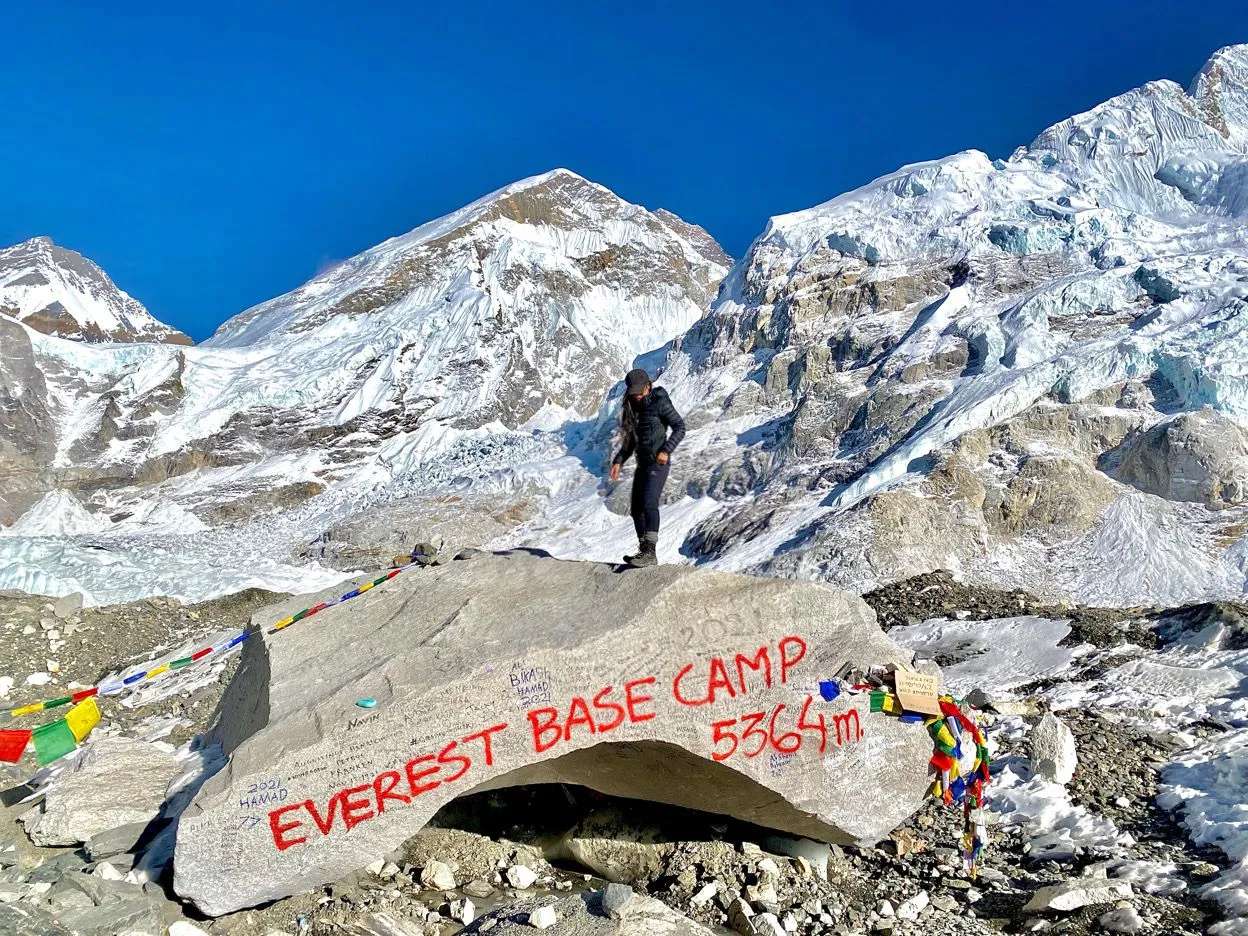
The Everest Base Camp Trek is a non-technical trekking route through Nepal’s Khumbu Valley that takes you from the small mountain airstrip of Lukla all the way to the base of Mount Everest, the world’s highest peak at 8,849 meters. You don’t climb. You don’t need ropes, crampons, or mountaineering skills of any kind. You walk. Across suspension bridges, through ancient Sherpa villages, past rhododendron forests and glacial rivers, alongside yak caravans and Buddhist monasteries, up rocky moraines and wind-scoured ridgelines, until you’re standing at 5,364 meters on the Khumbu Glacier with Nuptse and Lhotse towering above you and the realization hitting you that you actually did this.
The total route covers roughly 130 km round trip, takes between 12 and 16 days depending on your itinerary, and passes through some of the most extraordinary landscape on Earth. The trek starts with a flight from Kathmandu to Lukla Airport and passes through traditional Sherpa villages, beautiful forests, and glacial valleys before reaching Everest Base Camp. The infrastructure along the route is genuinely impressive; teahouses (family-run mountain guesthouses) provide a bed and hot food every few hours, making this a trail you sleep indoors on every single night. Is it worth it? Every single person who has stood at EBC and turned around to walk back down says the same thing: they wish they’d done it sooner.
Is the Everest Base Camp Trek Hard for a Beginner?
Yes, EBC is hard, but it’s hard in a way that is manageable with preparation, not hard in a way that requires special talent or years of experience. That distinction matters enormously for first-time trekkers trying to figure out whether this is actually for them.
The main challenges are altitude, duration, and daily mileage, not technical terrain. The difficulty rating of EBC is moderate to challenging. No climbing skills are necessary, but you should be reasonably fit. The primary challenges come from its altitude, long walking days of 5–7 hours per day, and basic services. Most EBC turnarounds happen not because of fitness failure but because of altitude sickness that wasn’t managed properly, which is entirely preventable with a correctly structured itinerary and the right acclimatization protocol.
How many hours a day will you be hiking on EBC?
You’ll be hiking between 5 and 8 hours per day on active trekking days, covering 10–18 kilometers depending on the section of trail. That doesn’t sound extreme until you factor in that you’re doing it for 12 consecutive days, at altitudes where your body is working harder than it ever has just to breathe, carrying a daypack with water, layers, and snacks while your larger pack goes with your porter.
The good news is that the trail itself is well-marked, well-traveled, and never technically demandingno ropes, no ladders, no cliff-edge scrambles. What separates people who love this trek from people who suffer through it is almost entirely preparation: regular workouts for your body for 2–3 months before your trek are a must. If you can hike 15 kilometers on a hilly trail with a 7 kg pack today without being completely wrecked the following morning, you have the physical base to build from.
Do you need prior trekking experience to do EBC?
No prior trekking experience is not required to complete the Everest Base Camp Trek. Thousands of first-time trekkers do it every single year, and the teahouse system and mandatory guide requirement in 2026 mean you’re never navigating logistics or safety decisions alone.
That said, having at least one or two multi-day hikes under your belt before departure will make the experience significantly more enjoyable. Those hikes teach you how your feet swell after back-to-back long days, how your sleep quality changes when you’re physically exhausted at altitude, and what your body needs in terms of nutrition and hydration when it’s under sustained stress. None of that is knowledge you can get from a YouTube video; you learn it by doing it, and the EBC trail at 4,500 meters is not the best place to learn it for the first time.
When Is the Best Time to Do the Everest Base Camp Trek in 2026?
The best time to trek Everest Base Camp is during spring (March to May) or autumn (October to November). These are the two weather windows that consistently deliver stable conditions, clear mountain views, and safe trekking temperatures at altitude.
Spring 2026, particularly April and May, is the most popular season on the trail for one spectacular reason: it coincides with Everest summit expedition season. As you approach base camp in late April, you’ll see the famous multicolored tent city of expedition teams spread across the Khumbu Glacier, preparing for their summit pushes. The rhododendrons are blooming in the lower valleys, the days are warming, and the Himalayan views are stunning. October and November offer arguably the clearest skies of the year, with the post-monsoon air scrubbed clean and Everest standing razor-sharp against a deep blue sky on a good day.
What months should you avoid for the EBC trek?
Avoid June through September (monsoon season) and December through February (deep winter). Monsoon season brings persistent cloud cover, muddy and leech-ridden trails below Namche Bazaar, dramatically increased flight delay frequency in and out of Lukla, and a generally miserable day-to-day experience even when the trail is technically passable.
Winter trekking on EBC is a different kind of problem; temperatures at Gorak Shep and Lobuche drop to well below -15°C at night, most teahouses above Dingboche close between December and February, and heavy snowfall on the upper trail creates genuine safety hazards for inexperienced trekkers. Some seasoned adventurers do it deliberately for the solitude and challenge, but for a beginner’s first EBC experience, spring or autumn is the right choice without question.
The Complete 14-Day EBC Itinerary for Beginners
The 14-day itinerary is the gold standard for first-time EBC trekkers, and the reason is simple: it includes two dedicated acclimatization days that most 12-day itineraries skip. Rushing the ascent is the single most common reason trekkers fail to reach base camp. The mountain doesn’t care about your flight home. It responds to patience.
For most trekkers, April–May and October–November 2026 are ideal seasons to follow this classic and highly recommended route for altitude safety.Below is the complete day-by-day breakdown of the 14-day itinerary we recommend at Wilder Way Trekking for all beginner groups.
Days 1–2: Kathmandu Permits, Preparation, and Cultural Grounding
You land in Kathmandu, and you’re immediately inside the most organized chaos you’ve ever experienced: motorbikes threading between temples, incense smoke mixing with diesel fumes, and vendors selling prayer flags beside phone repair shops. Days 1 and 2 aren’t hiking days. They’re the days you collect permits, attend your pre-trek briefing, do a final gear check with your guide, sort your currency (get Nepali rupees for tips and trail purchases), and if time allows, visit Boudhanath Stupa or Pashupatinath Temple for a bit of spiritual context before the mountains.
Do not underestimate the value of this time. Every problem you solve in Kathmandu costs you an hour and a taxi ride. The same problem at 4,200 meters could cost you your trek. Check that your boots have been broken in. Confirm your sleeping bag temperature rating. Verify your travel insurance covers helicopter evacuation to 6,000 meters. Make sure your guide has your permit documents in hand before you go anywhere near a plane.
Day 3: Fly Kathmandu (or Ramechhap) to Lukla Trek to Phakding (2,610m)
The Lukla flight is a rite of passage that nobody describes accurately in advance. The plane is small, the runway is 527 meters long and tilted uphill toward a mountain wall, and the landing is more of a controlled fall than a graceful touchdown. Then the door opens, the Himalayan air hits you, and you’re somewhere entirely different from anywhere you’ve been before.
From Lukla, you begin trekking along the Dudh Koshi River toward Phakding, a 3–4 hour gentle descent that serves as the perfect warm-up for what’s ahead. The trails are wide, the bridges are bouncy in a way nobody warned you about, and you’ll probably pass your first yak train within the first hour. Phakding sits at 2,610 meters, lower than Lukla, which is your body’s first acclimatization gift without you even knowing it.
Days 4–5: Namche Bazaar (3,440 m)The Gateway and the First Acclimatization Day
The climb into Namche Bazaar from Phakding is the first real test of the trek: approximately 800 meters of vertical gain over a long, steep ascent that winds through pine forest, across the famous Hillary Suspension Bridge, and up a relentless switchback trail that has humbled more than a few overconfident trekkers on day one. And then you turn a corner, the valley opens up, and you get your first proper view of Everest’s summit peeking between the ridges. That view, after that climb, is worth every labored breath.
Namche Bazaar is the capital of the Khumbu region, a proper, functioning mountain town with bakeries serving cinnamon rolls, gear shops stocked with everything you forgot to pack, an ATM (use it; it’s the last one), reliable Wi-Fi, and a whole community of Sherpa families who have been guiding and hosting trekkers for generations. Day 5 is your first dedicated acclimatization day. You don’t rest completely; the protocol is climb high, sleep low, so you’ll hike up to the Everest View Hotel at 3,880 meters and return to Namche to sleep. This is how your body learns to live at altitude: push it a little higher than your sleeping elevation, let it adapt, and bring it back down.
Day 6: Tengboche Monastery (3,860 m) The Most Photographed Place on the Trek
Tengboche is where most people stop mid-stride, pull out their phone or camera, and completely forget to keep walking. The monastery sits at the edge of a ridge with Ama Dablam, a peak so geometrically perfect it looks like an architect designed it, rising directly behind it, and on a clear day, Everest and Lhotse are visible in the distance. Tengboche is a famous monastery with an amazing view of Everest and one of the most spiritual places in the region.
If the timing works in your favor, the monks will be chanting evening prayers when you hear a sound that echoes off the mountains in a way that makes altitude headaches feel briefly irrelevant. This is also the day your appetite may start to shift. Above 3,500 meters, many trekkers find they’re less hungry than usual. This is it’s altitude-related, and it’s your cue to eat anyway. Dal Bhat, the trail staple of rice and lentils with vegetables, is at most teahouses. Eat it even when you don’t feel like it.
Days 7–8: Dingboche (4,410 m) The Altitude Jump and the Second Acclimatization Day
Dingboche is where the Khumbu Valley opens into a wider, starker, more exposed world. You’ve crossed above 4,000 meters, the vegetation has thinned dramatically, the air is noticeably thinner, and most trekkers feel some combination of mild headache, reduced appetite, and disrupted sleep here for the first time. This is all completely normal and is not a reason to panic or turn around. It means your body is doing exactly what it should be doing.
Day 8 is your second dedicated acclimatization day, and it’s arguably the most important day of the entire trek. You’ll hike up to Nangkartshang Peak at approximately 5,100 meters, technically higher than Everest Base Camp itself, before returning to Dingboche to sleep at 4,410 meters. By the time you leave for Lobuche the following morning, your body will have made meaningful physiological adaptations: more red blood cells, better oxygen utilization, and a lower resting heart rate at altitude. These adaptations are what make the final push to base camp possible for a body that was at sea level two weeks ago.
Day 9: Lobuche (4,940 m)The Terrain Shifts
The walk to Lobuche is the day the landscape loses any remaining trace of softness. The green valleys of the lower Khumbu are a memory. You’re walking through boulder fields, crossing glacial moraines, and navigating a rocky trail that offers no shade and little shelter from the wind that picks up in the afternoons at this altitude. The surrounding peaks, Pumori, Nuptse, and Lobuche itself, are enormous in a way that photos genuinely cannot capture.
Lobuche sits at just under 5,000 meters, and the nights here are the coldest you’ll experience below base camp. This is the night your -20°C down jacket earns every dollar you spent on it. The teahouses at Lobuche are more basic than anything below Dingboche: thinner walls, less reliable solar power, and menus that have contracted considerably. But by this point in the trek, you’re so close to the goal that none of it matters. You eat, you layer up, you sleep, and you get ready for the big day.
Day 10: Gorak Shep (5,164m) and Everest Base Camp (5,364 m) The Day You Came For
Leave Gorak Shep with just your daypack, water, snacks, and warm layers. The trail to EBC follows the edge of the Khumbu Glacier, picking through loose rock and glacier debris in a way that is slow, careful, and deeply absorbing. At this altitude, your pace is deliberate. Your steps are smaller than you’d like. Your breathing is the loudest sound you can hear.
And then, eventually, you get there. There’s no dramatic visual payoff at base. Everest’s summit is actually hidden from EBC behind the shoulder of Nuptse. What you see is the Khumbu Glacier, prayer flags strung between cairns, and the raw, wild scale of the highest mountain environment on Earth. When you stand at sunrise on Kala Patthar and see Everest glowing in the first light, something shifts. You will feel proud in a way that is hard to describe.Explore all about Nepal. People cry at base camp. Regularly. Even people who absolutely did not expect to.
Day 11: Kala Patthar Sunrise (5,545m) The Best View of Everest
The 5:00am alarm at Gorak Shep is brutal in the way that only very cold darkness can be. You layer everything you brought. You click on your headlamp. You start climbing Kala Patthar before dawn, and for the first twenty minutes your body genuinely resents every aspect of this decision. Then the sky begins to lighten, Everest’s summit pyramid appears against a deepening blue, and by the time you reach the top and the sun clears the ridgeline, you understand completely why people set that alarm.
Kala Patthar, at 5,545 meters, offers the best and most accessible view of Everest’s summit of anywhere on the trek. From EBC itself, the summit is hidden. From Kala Patthar, it’s right there, enormous, close enough to see the plume of wind-driven snow off the summit ridge, surrounded by Nuptse, Changtse, and the Western Cwm. After sunrise, you descend to Gorak Shep, pack up, and begin the long walk back down toward Pheriche. Going down is faster, harder on the knees, and bittersweet in the way that endings always are.
Days 12–14: Descent to Lukla-Legs, Nostalgia, and Celebration
The descent covers in three days what took ten days to climb. Your cardiovascular system is working fine.better than when you arrived, actually but your quadriceps and knees take serious punishment on the long downhill sections. Trekking poles are not optional on the descent. Bring them, use them, and your knees will be grateful.
By the time you reach Lukla on Day 14, you’ll have covered roughly 130 kilometers, gained and lost thousands of meters of elevation, slept in a dozen different teahouses, eaten more Dal Bhat than you thought possible, and done something that most people only ever dream about. The celebration dinner at one of Lukla’s teahouses with your guide, your porter, and however many trail friends you’ve collected along the way is one of those evenings that gets retold for years.
What Permits Do You Need for the EBC Trek in 2026?
You need two mandatory permits to trek to Everest Base Camp in 2026, and both are essential; they’re checked at multiple points on the trail, and you will be turned back without them.
The first is the Sagarmatha National Park Permit, which costs around $30 per person and can be obtained in Kathmandu or at the Monjo entrance gate. The second is the Khumbu Pasang Lhamu Rural Municipality Permit, which costs about $20 and is issued in Lukla or Monjo. The TIMS card is not required for this trek, as the local Khumbu permit has replaced it. Everest Keep both permits in a waterproof document sleeve in your daypack at all times. Checkpoints at Monjo and Namche Bazaar will inspect them, and the rangers at these gates are thorough.
Is there a new green fee for EBC in 2026?
Yes, a new environmental green fee of $8 per trekker has been introduced for the Khumbu region in 2026 as part of Nepal’s effort to fund sustainable conservation of the Sagarmatha National Park ecosystem. This fee goes toward trail maintenance, waste management, and the environmental protection of one of the world’s most visited high-altitude zones.
Your trekking agency will typically collect and pay this fee on your behalf as part of your package, but confirm this explicitly when you book. If you’re organizing permits independently, budget for this additional $8 on top of the two main permit fees. In total, your permit costs in 2026 will be approximately $58 USD, a small fraction of your overall budget, but a non-negotiable one.
How Much Does the EBC Trek Cost in 2026? The Real Numbers
The total cost of an Everest Base Camp trek in 2026 depends primarily on three variables: whether you book a guided package or organize independently, what season you go, and what level of accommodation and add-ons you include. A standard guided package typically costs $1,400–$2,500, covering the guide, porter, accommodation, most meals, permits, and Lukla flights. A premium guided trek with higher-end teahouses and experienced senior guides runs $2,500–$4,000.
For an all-in budget that includes international flights to Kathmandu, Nepal, a visa, a trekking package, gear, travel insurance, tips, and spending money on the trail, plan on $3,500–$5,500 depending on where you’re flying from and what choices you make. That’s a significant investment, but it’s genuinely competitive with other bucket-list international adventures of comparable scope, and it supports a local economy that depends on trekking tourism.
What’s included in a typical EBC package from a trekking agency?
A quality EBC trekking package from a reputable local agency like Wilder Way Trekking will include a licensed English-speaking guide, porter service (up to 15 kg of your gear), all teahouse accommodation on the trail, all meals from day one at Lukla to the final day return, domestic Kathmandu–Lukla–Kathmandu flights (or Ramechhap–Lukla if diverted), all mandatory permits and fees, trekking poles if needed, a sleeping bag rated to -20°C if you don’t own one, a comprehensive first-aid kit carried by your guide, and emergency oxygen for guide use.
What’s typically not included: international flights, Nepal entry visa, travel insurance (mandatoryget your own that explicitly covers helicopter evacuation to 6,000 m), personal gear and clothing, tips for your guide and porter (budget $150–$200 minimumthey earn it), and extras on the trail like Wi-Fi cards, hot showers, battery charging, and alcohol. Avoid agencies offering suspiciously low prices; they typically cut corners on guide qualifications, porter welfare, or emergency preparedness.The cheapest EBC package is not a bargain if your guide isn’t qualified, your porter isn’t insured, or your itinerary skips acclimatization days.
What does daily spending on the trail actually cost?
Daily spending on the trail in 2026 sits between $40 and $80 per person for meals and accommodation, rising significantly as you gain altitude. At Phakding and Namche Bazaar, a basic twin room costs $5–$10 per night (often free if you commit to eating all your meals at that teahouse), and a main meal runs $5–$12. By the time you’re at Lobuche and Gorak Shep, the same basic room costs more, and the food prices have roughly doubled from the lower elevations.
Everything at high altitude has to be carried there by porters or yak, and that transportation cost is reflected directly in the price of your evening bowl of pasta or your morning cup of milk tea. A Wi-Fi card (Everest Link) costs around $6–$10 and provides slow but usable internet that drops to nearly unusable above Dingboche. Charging your phone or camera battery at a teahouse costs $2–$5 per device. Bring a large power bank (20,000 mAh minimum) and use it; it will save you a meaningful amount of money and frustration over a 12-night stay.
What Gear Do You Need for the EBC Trek as a Beginner?
The golden rule for EBC packing is this: no cotton, no exceptions, and nothing over 15 kilograms for your porter bag. Cotton absorbs sweat and holds it against your skin, and at altitude in a Himalayan wind, that moisture pulls heat from your body with terrifying efficiency. Everything you wear on the trail should be merino wool, synthetic moisture-wicking fabric, fleece, down, or GORE-TEX.
The three-layer clothing system is the foundation of everything: a merino wool or synthetic base layer next to your skin, a mid-layer fleece for insulation, and a GORE-TEX outer shell for wind and weather protection. On top of this core system, your down jacket rated to at minimum -20°C is the single most important piece of clothing you’ll pack. Nights at Lobuche and Gorak Shep are genuinely brutal. A regular winter jacket that’s fine for European skiing will not protect you adequately above 4,800 meters.
What footwear do you need for EBC?
You need waterproof, GORE-TEX-lined, high-cut trekking boots with a Vibram or equivalent lug sole, and you need them broken in for at least 4–6 weeks before you fly to Kathmandu. The high-cut design provides ankle support on rocky, uneven terrain above Dingboche and Lobuche. The waterproof lining keeps your feet dry through stream crossings, snow, and the wet rocky sections above 4,500 meters.
The single most important thing about boots for EBC is the break-in period. Brand new boots on day one of a 14-day trek are a guaranteed blister disaster. Wear your chosen boots on 4–6 long hikes (ideally including one full-day hike with a loaded pack) before departure. Identify any friction hotspots early and address them with moleskin or blister tape before they become open sores. Your feet are your vehicle for this entire journey; treat them accordingly.
What’s the full packing list for an EBC beginner?
Here is the complete gear list broken into categories:
Clothing: 2× merino or synthetic long-sleeve base layers, 2× thermal base layer bottoms, fleece jacket (200–300 g weight class), down jacket rated -20°C, GORE-TEX shell jacket, waterproof trekking pants or over-trousers, trekking shirts (3×, quick-dry), warm hat covering ears, sun hat with brim, balaclava for Kala Patthar summit, liner gloves, waterproof insulated gloves, wool hiking socks (4×), lightweight camp shoes (Crocs or sandals for teahouses).
Gear: Daypack (25–30 L for hiking each day), sleeping bag (-10°C to -15°C rating; can rent in Kathmandu), trekking poles (collapsible, wrist-strapped), headlamp with extra batteries (×2 sets), dry bags (20 L for sleeping bag, 10 L for electronics), water bottle (1 L hard-sided + 1 L soft flask), water purification tablets or LifeStraw filter, power bank (20,000 mAh minimum), universal adapter, sunscreen SPF 50+, UV-protection sunglasses, and lip balm with SPF.
Health and Documents: Diamox (Acetazolamide) (get prescription before leaving home), blister kit (moleskin, needle, antiseptic), pulse oximeter (small, cheap, invaluable for monitoring blood oxygen saturation), basic first aid kit, prescribed medications plus 30% extra supply, travel insurance documents (physical copies, not just phone), permit copies in waterproof sleeve, passport photos (3–4 extra for permit checkpoints).
Altitude Sickness on EBC: What Every Beginner Must Know
Altitude sickness is the number one reason EBC treks end early, and it is the one risk on this trail that cannot be trained for, cannot be predicted, and does not respect fitness level, age, or prior mountain experience. Understanding how it works and how to respond to it is not optional knowledge for an EBC trekker; it is fundamental.
Acute Mountain Sickness (AMS) occurs when your body doesn’t acclimatize fast enough to the reduced oxygen at altitude. The primary symptoms are a persistent headache that doesn’t clear fully with paracetamol, nausea or vomiting, fatigue that seems disproportionate to your activity level, dizziness, disrupted sleep with unusual breathing patterns, and complete loss of appetite. Altitude sickness is real, and with a structured itinerary, proper acclimatization days, and an experienced guide, EBC is considered safe for prepared trekkers.The key word there is “structured”; an itinerary that skips acclimatization days is an itinerary that dramatically increases your AMS risk.
How do you tell the difference between AMS and normal tiredness?
Normal tiredness on the EBC trail improves significantly after 30–60 minutes of rest. AMS symptoms persist or worsen even after rest. Normal fatigue is localized muscle soreness, sore calves, aching quads, and tired feet. AMS is systemic; it shows up as headache, nausea, mental fog, and breathlessness at rest.
The most important diagnostic question is: are your symptoms improving or worsening over time? If you rest for an hour, eat something, drink water, and feel noticeably fatigued, and you continue. If you rest, and an hour later the headache is the same or worse, the nausea is still there, and you feel more disoriented rather than less, that is AMS, and the correct response is do not ascend further tonight. If symptoms continue worsening after stopping the ascent, descend. Even descending 300–500 meters can make a significant difference in how your body responds.
What are HAPE and HACE, and how serious are they?
HAPE (High Altitude Pulmonary Edema) and HACE (High Altitude Cerebral Edema) are the life-threatening escalations of AMS that require immediate emergency actionno waiting, no sleeping it off, no hoping for morning.
HAPE is fluid accumulation in the lungs. Symptoms include severe shortness of breath at rest, a persistent wet cough, pink or frothy sputum, and extreme fatigue even without physical exertion. HACE is fluid on the brain. Symptoms include a severe headache that doesn’t respond to any medication, inability to walk in a straight line (ataxia), confusion, and, in advanced cases, loss of consciousness. If you or anyone in your group develops these symptoms at altitude, the protocol is the same: descend immediately, administer emergency oxygen if available, and call for helicopter evacuation. Emergency helicopter rescue is available from anywhere on the EBC trail, but it requires travel insurance that explicitly covers high-altitude helicopter evacuation, typically to 6,000 meters. Without insurance, that helicopter bill can exceed $5,000 USD. With proper insurance, you pay nothing.
Should you take Diamox for the EBC trek?
Diamox (acetazolamide) is a prescription medication that helps your body acclimatize more efficiently by triggering faster, deeper breathing and increasing blood oxygen saturation. It is not a cure for altitude, and it is not a substitute for proper acclimatization days. It is a tool that, used correctly, gives your body a meaningful advantage in adapting to altitude.
The standard dosage is 125–250 mg twice daily, typically starting 1–2 days before your significant altitude gain begins (usually the day before leaving Namche for Tengboche). Side effects include tingling or numbness in hands, feet, and face, and significantly increased urination, both of which are normal and manageable. Get a prescription from your GP before leaving home. Do not buy it from a trail pharmacy at Namche without a prescription; the quality and dosage accuracy of medications sold at altitude cannot be verified reliably.
Guide Rules for EBC in 2026 What Changed and Why It Matters
Since 2023, trekking in the Everest region without a licensed guide has been illegal. This rule has been enforced with increasing strictness through 2024 and is being applied rigorously in 2026, with checkpoints at Monjo and Namche specifically checking that every trekker is accompanied by a registered, licensed guide. A new rule in Nepal states that every trekker going to Everest Base Camp has to hire a registered guide. You cannot trek solo anymore.
For beginners, this rule is entirely positive. A qualified EBC guide does far more than navigate; they pace you intelligently (preventing the most common beginner mistake of going too fast in the first few days), monitor your health and blood oxygen levels, manage all permit checks and teahouse logistics, communicate with local contacts in Sherpa dialects at checkpoints, and make judgment calls about whether to push on or rest that are based on hundreds of days of experience on this specific trail. The guide fee, typically $25–$35 per day plus their food and accommodation, is among the best value investments you will make in your entire EBC budget.
How do you choose a good EBC guide?
A good EBC guide will be registered with the Nepal Tourism Board (you can verify registration numbers online), have substantial prior experience on the specific EBC route not just general Nepal trekking, carry a first aid kit and know how to use it, speak fluent English, and have a calm, communicative approach to health monitoring and daily pacing decisions.
At Wilder Way Trekking, all our guides are locally trained, Nepal Tourism Board registered, and first-aid certified and have completed the EBC route a minimum of 20 times. We match guides to group profiles; solo female trekkers can request female guides (book early, availability is limited), families with children are matched with guides experienced in that specific pacing, and experienced trekkers looking for a faster pace can request accordingly. The relationship between trekker and guide makes an enormous difference in how much you enjoy this experience; treat it as a meaningful choice, not an administrative detail.
What about porters? Do you need one?
You don’t have to have a porter, but we genuinely recommend it for a first EBC trek. Your porter carries your main bag (up to 15 kilograms), leaving you to hike with just a daypack containing water, snacks, a camera, and layers. The physical difference between hiking with 5 kg and hiking with 15 kg at altitude is not the difference between being able to look around and enjoy what you’re walking through versus staring at your feet and counting steps.
Porters work extremely hard and earn low base wages; tip generously, at minimum $10–$15 per day on top of their salary. Ensure your agency confirms that your porter is insured (as required by Nepalese labor law), has adequate clothing and equipment for the altitude they’re working at, and is not being asked to carry more than the regulated 25 kg porter limit. Ethical porter practice is one of the most important things to check about any trekking agency you consider booking with.
What Are Teahouses Like on the EBC Trek?
A teahouse is a family-run mountain guesthouse that serves as your accommodation and dining room for every night of the trek. At lower Namche, Tengboche teahouses are surprisingly comfortable: twin rooms with actual mattresses, pillows, and warm blankets; common dining halls heated by yak-dung stoves; menus that run from Dal Bhat to pasta, pizza, pancakes, and apple pie; and reasonable Wi-Fi available through Everest Link cards purchased at Namche for around $6–$10.
Above Dingboche, the experience becomes more basic in proportion to the altitude. Rooms at Lobuche and Gorak Shep are thin-walled, cold, minimally furnished, and share toilet facilities that require a headlamp to navigate at 3am. The food menu contracts to a core of reliable high-calorie optionssoup, noodles, dal bhat, and porridgeand the prices increase significantly. None of this diminishes the warmth and genuine hospitality of Sherpa teahouse families who have been welcoming trekkers for decades. At 5,000 meters in the dark, in the cold, with the wind off the glacier outside, a bowl of hot soup and a place to sleep feel like extraordinary luxury.
What food should you eat on the EBC trek?
Dal Bhat (rice with lentil soup, vegetable curry, and pickle) is the undisputed king of the EBC trail for a reason: it’s filling, delicious, high in carbohydrates and protein, easy to digest at altitude, and crucially, unlimited refills are standard at most teahouses. It’s what your guides and porters eat it; it’s freshly cooked at every teahouse, and it provides the sustained energy you need for long hiking days.
Above 3,500 meters, your appetite will likely decrease due to altitude. This is normal and expected, but it creates a problem: your body needs calories to sustain the physical output and thermoregulation demands of high-altitude trekking even when your appetite says otherwise. Force yourself to eat at every meal, even if it’s just half a portion. Prioritize warm liquids: herbal tea, hot lemon water, and ginger tea to stay hydrated and warm simultaneously. Avoid alcohol above 3,500 meters (it dehydrates and interferes with acclimatization), and limit coffee to mornings if you must have it.
Lukla Flights in 2026 What Beginners Need to Know
The Tenzing-Hillary Airport at Lukla is, by almost any measure, one of the most dramatically situated airports on Earth, with a 527-meter sloped runway, a mountain wall at one end, a sheer drop at the other, high-altitude weather that changes rapidly, and flight schedules that exist more as optimistic suggestions than firm commitments. Flights from Kathmandu to Lukla operate on Twin Otter and Dornier aircraft with strict weight limits: 15 kg checked baggage plus 5 kg carry-on per passenger, enforced without exception.
During peak spring season (April–May) and peak autumn season (October), Kathmandu’s air traffic is congested enough that the Nepal Civil Aviation Authority routes a significant proportion of Lukla flights through Ramechhap (Manthali) Airport, a 4–5 hour drive from Kathmandu along the BP Highway. If your departure falls in these periods, your agency will almost certainly have you taking a 9–11pm night bus or private jeep from Kathmandu to Ramechhap to catch an early morning departure to Lukla. Build this into your expectations and your schedule; it’s disruptive to your sleep but otherwise manageable.
What happens if your Lukla flight is delayed or cancelled?
Weather delays on Lukla flights are not unusual; they’re a normal part of the EBC experience that every experienced operator plans for. Clouds, fog, and wind can close the airport for hours or a full day with very little warning. This is precisely why every EBC itinerary should include 1–2 buffer days at either the beginning or end of the trek.
If your flight is delayed on the way in, you wait in Kathmandu (or Ramechhap) until conditions clear; your agency will manage the rebooking. If your flight is delayed on the way out from Lukla, you have the option of waiting for conditions to improve (usually the best choice for one-day delays) or upgrading to a helicopter evacuation from Lukla or Gorak Shep if your schedule is genuinely inflexible, typically costing $250–$500 per person when split among five passengers. Travel insurance that covers flight delay disruption is worth checking, as some policies include trip disruption coverage for exactly this scenario.
Why Trek EBC with Wilder Way Trekking in 2026?
There are a lot of trekking operators on the EBC market in 2026, from international booking platforms that outsource everything to local teams (while taking a 20–30% commission that comes from somewhere in your experience quality), to budget agencies that offer headline prices that don’t survive contact with the actual permit, flight, and guide costs. We’re not the cheapest option, and we don’t try to be.
At Wilder Way Trekking, our EBC packages are designed specifically for the beginner experience: 14-day itineraries with no skipped acclimatization days, Nepal Tourism Board-registered guides with 20+ EBC completions, daily health monitoring with pulse oximetry, small group sizes of maximum 8 trekkers, and fully transparent pricing that includes every permit, domestic flight, guide, porter, meal, and accommodation from day one. We offer customizable packages for solo travelers joining a group departure, private bookings for couples and families, and combined itineraries with Gokyo Lakes or Island Peak for returning trekkers looking for the next challenge.
Ready to make 2026 the year you actually do this? Contact our team at Wilder Way Trekking for a free custom itinerary; we’ll match you with the right departure date, guide profile, and package for your specific fitness level, budget, and goals.
FAQ
Can a complete beginner do the Everest Base Camp Trek in 2026?
Yes, a complete beginner can trek to Everest Base Camp in 2026. The EBC trail is a non-technical trekking route; no climbing skills, ropes, or crampons are required. The key requirements are 10–12 weeks of physical preparation before departure, a 14-day itinerary with built-in acclimatization days at Namche Bazaar and Dingboche (4,410 m), a Nepal Tourism Board licensed guide (mandatory by law since 2023), and travel insurance covering helicopter evacuation to 6,000 meters. Thousands of first-time trekkers with no prior Himalayan experience complete EBC every season through Wilder Way Trekking’s beginner-specific guided packages.
How long does the Everest Base Camp Trek take for a beginner?
The Everest Base Camp Trek takes 14 days for beginners following the recommended standard itinerary. The 14-day schedule includes two dedicated acclimatization days at Namche Bazaar (Day 5) and one at Dingboche (Day 8), which are non-negotiable for safe altitude gain. The route covers approximately 130 kilometers round trip from Lukla to EBC and back. A 12-day itinerary exists but skips acclimatization days, significantly increasing the risk of Acute Mountain Sickness (AMS) for first-time trekkers. For beginners in 2026, 14 days is the safest and most enjoyable option.
How much does the Everest Base Camp Trek cost in 2026?
The total cost of the Everest Base Camp Trek in 2026 ranges from $3,500 to $5,500 all-inclusive. A guided trekking package from a local agency like Wilder Way Trekking costs $1,400–$2,500 and covers a licensed guide, porter, all teahouse accommodation, all meals on trail, domestic Kathmandu–Lukla flights, and all permits. Permits alone total approximately $58 USD for the Sagarmatha National Park entry fee ($30), the Khumbu Pasang Lhamu Rural Municipality Permit ($20), and the new 2026 Green Fee ($8). Daily spending on the trail runs $40–$80 per person for food and accommodation, rising at higher altitudes. International flights, Nepal visas, personal gear, travel insurance, and guide and porter tips are additional costs.
Is a guide mandatory for the Everest Base Camp Trek in 2026?
Yes, a licensed guide is legally mandatory for the Everest Base Camp Trek in 2026. Nepal’s government made licensed guide accompaniment compulsory for all Everest region treks in 2023, and enforcement has increased significantly through 2024 and 2026. Permit checkpoints at Monjo and Namche Bazaar verify that every trekker is accompanied by a Nepal Tourism Board-registered guide. Solo, guideless trekking in the Khumbu region is not permitted, and trekkers found without a guide at checkpoints are turned back. A licensed EBC guide from Wilder Way Trekking costs $25–$35 per day and manages pacing, health monitoring, teahouse logistics, and emergency response throughout the trek.
What are the symptoms of altitude sickness on the Everest Base Camp Trek?
The primary symptoms of altitude sickness (acute mountain sickness, or AMS) on the Everest Base Camp Trek are a persistent headache that does not fully clear with paracetamol, nausea or vomiting, fatigue disproportionate to physical effort, dizziness, disrupted sleep with irregular breathing, and complete loss of appetite. These symptoms typically appear above 3,000 meters and are most commonly felt between Namche Bazaar (3,440 m) and Dingboche (4,410 m). If symptoms worsen after rest rather than improve, the correct response is to stop ascending. If symptoms continue deteriorating, especially breathlessness at rest (HAPE) or confusion and inability to walk straight (HACE), immediate descent and emergency helicopter evacuation are required. Travel insurance covering helicopter rescue to 6,000 meters is mandatory for all EBC trekkers.
What permits do you need for the Everest Base Camp Trek in 2026?
Trekkers need three permits for the Everest Base Camp Trek in 2026. The first is the Sagarmatha National Park Entry Permit, which costs $30 USD and grants access to the UNESCO World Heritage Site surrounding Everest. The second is the Khumbu Pasang Lhamu Rural Municipality Permit, which costs approximately $20 USD and is issued at Lukla or Monjo. The third is the new 2026 Green Fee of $8 USD per trekker, introduced to fund environmental conservation in the Khumbu region. The TIMS card is no longer required for the Everest region. Total permit cost is approximately $58 USD per person. Reputable trekking agencies the trail,ilder Way Trekking handle all permit collection and checkpoint documentation on behalf of their clients.
What is the best time to trek Everest Base Camp in 2026?
The best time to trek Everest Base Camp in 2026 is during spring (March to May) or autumn (October to November). Spring offers blooming rhododendrons in the lower valleys, stable weather, and the unique experience of witnessing active Everest summit expedition teams at base camp during April and May. Autumn delivers the clearest mountain visibility of the year following the monsoon season, with Everest and surrounding peaks sharp against a deep blue sky on good days in October and November. June through September should be avoided due to monsoon rainfall, trail mud, leeches below Namche Bazaar, and frequent Lukla flight cancellations. December through February should be avoided due to extreme cold below -15°C at high altitude and closure of most teahouses above Dingboche.
What is the Lukla flight situation for EBC trekkers in 2026?
In 2026, many Lukla flights during peak spring and autumn seasons depart from Ramechhap (Manthali Airport) rather than Kathmandu due to ongoing air traffic congestion management by Nepal’s Civil Aviation Authority. Ramechhap is a 4–5 hour drive from Kathmandu along the BP Highway, requiring trekkers to travel overnight by bus or private jeep to catch early morning departures to Lukla. The flight from Ramechhap to Lukla takes 15–20 minutes on Twin Otter or Dornier aircraft with a strict 15 kg checked baggage and 5 kg carry-on limit. Weather delays at Lukla are common; all EBC itineraries should include 1–2 buffer days to account for flight disruption. Helicopter transfer from Kathmandu or Ramechhap to Lukla is available as an upgrade for approximately $300–$500 per person when shared among five passengers
Leave a comment: