

- 116 Views
- 20 Min Read
- (0) Comment
Have you ever booked a flight, packed your bags, and traveled halfway across the world only to realize you picked the completely wrong month to see the mountains? It happens way more often than you think, and honestly, getting socked in by thick white clouds when you paid good money to see the Annapurna range is a pretty terrible feeling. The Himalayas are undeniably beautiful, but they are also incredibly moody depending on the calender, and picking the wrong dates can ruin months of training.
In this blog, we are breaking down exactly what the best time for annapurna base camp trek actually looks like so you don’t waste your precious vacation days. We will cover the spring and autumn seasons in deep detail, explain why summer and winter are highly risky, and give you a clear month-by-month weather guide so you can plan the perfect trip.
What is the best time for Annapurna Base Camp trek?
The absolute best time for annapurna base camp trek is during the autumn months of October and November, closely followed by the spring months of March and April. During these months, the monsoon rains have stopped, and the skies become crystal clear. You will experience stable weather, dry stone steps, and perfect visibility of the surrounding 7,000-meter peaks without the danger of extreme cold or heavy snow.
Choosing the right months ensures your physical effort is rewarded with stunning mountain panoramas instead of a wall of white clouds. The moderate temperatures at lower elevations like Nayapul and Chhomrong make daily walking much more comfortable for beginners. By avoiding the wet and freezing seasons, you drastically reduce the risk of altitude sickness complications, making your journey to the 4,130-meter base camp much safer and far more enjoyable.
Why is weather so important for this specific trek?
Weather is incredibly important for this trek because the base camp sits deep inside a high-altitude glacial valley where conditions change rapidly and can become dangerous. If a heavy snowstorm hits, the trails can be buried, and the risk of avalanches near Machapuchare Base Camp increases significantly. Bad weather also means zero visibility, meaning you might hike for a week just to stare at a gray cloud instead of Annapurna I.
Furthermore, your flights to and from Pokhara are heavily dependent on the weather. During the monsoon or winter, flights get canceled for days, which can completely ruin your tight travel schedule and cause you to miss the trek entirely. Good weather guarantees that your expensive permits, guide bookings, and training do not go to waste, allowing you to walk the trail safely and fly home on time.
When do the four trekking seasons happen in Nepal?
The four trekking seasons in Nepal are neatly divided by the monsoon patterns, with spring running from March to May, summer from June to August, autumn from September to November, and winter from December to February. Autumn and spring are considered the high trekking seasons because they offer the perfect balance of clear skies and safe temperatures. Summer brings the heavy monsoon rains, while winter brings deep snow and freezing temperatures.
Understanding this seasonal calender is crucial because the transition from summer to autumn happens very quickly in late September. Similarly, the winter cold sets in rapidly by late November, catching unprepared trekkers off guard at high altitudes. Planning your departure date to align perfectly with the start or middle of these safe windows ensures you get the most out of your journey to the sanctuary.
How does the altitude affect the weather?
Altitude drastically affects the weather on this trail because for every 1,000 meters you climb, the temperature drops by about 6 degrees Celsius. While it might be a hot 25 degrees Celsius in Pokhara at 800 meters, it will be well below freezing at night when you reach the 4,130-meter base camp. The thin air at high altitude also means the sun feels incredibly hot during the day, but the moment a cloud covers the sun, you instantly freeze.
This extreme temperature fluctuation means you have to pack for four different seasons in a single backpack, regardless of which month you choose. The altitude also causes unpredictable microclimates; it might be sunny at Bamboo, but completely snowing at Annapurna Base Camp just two hours away. You must always carry waterproof layers and down jackets, because the weather at the top of the sanctuary does not care what season it is down in the valleys.
Where do you find the clearest skies?
You will find the clearest skies during the best time for annapurna base camp trek at high-altitude viewpoints like Poon Hill and directly at the Annapurna Base Camp glacier. In the early mornings of October and November, there is literally zero cloud cover in the sky. The sunrise lights up the south face of Machapuchare, Annapurna South, and Hiunchuli with brilliant gold and pink colors that photographers dream about capturing.
Lower villages like Tadapani and Chhomrong also offer amazing views, but the midday heat in the valleys often builds up cumulus clouds by the afternoon, even in good seasons. To guarantee those perfect postcard shots, you must reach your high-altitude destinations early in the morning before the clouds roll in. Waking up in the freezing dark at base camp is totally worth it when the sky lights up without a single cloud in the way.
Deep Dive: Autumn (October & November) – The Undisputed King
If you ask any local guide, any tea house owner, or any seasoned trekker what the absolute peak season is, they will all tell you the same thing: Autumn. After the brutal summer monsoons wash the entire country, the skies literally scrub themselves clean. The haze, the dust, and the pollution are entirely swept away, leaving behind a vacuum of crisp, dry air that offers visibility stretching for hundreds of miles. Read more about annapurna base camp itinerary 10 days.
The Vibe and Trail Conditions
Walking the trail in October is a sensory delight. The stone steps are completely dry, meaning you don’t have to worry about slipping and breaking an ankle on the way down from Ulleri or Chhomrong. The air is cool enough that you won’t sweat buckets during the steep climbs, but warm enough in the sun that you can hike in a t-shirt at lower altitudes like Tikhedhunga and Bamboo.
The cultural vibe is also incredible. Autumn overlaps with Nepal’s biggest festivals, Dashain and Tihar. As you walk through the villages, you will see houses decorated with colorful flowers, marigold garlands strung across the paths, and intricate chalk drawings (mandalas) on the ground. The locals are in a celebratory mood, and the feeling of warmth and hospitality in the tea houses is at its absolute highest.
The Temperatures
The temperature breakdown in autumn is as close to perfect as you can get in the Himalayas. In Pokhara and Nayapul at the start of the trek, daytime highs sit around 20°C to 25°C (68°F to 77°F). As you climb into the mid-hills like Ghorepani and Tadapani, daytime temperatures sit comfortably around 12°C to 15°C (53°F to 59°F).
Once you cross into the sanctuary and reach Annapurna Base Camp, the daytime temperatures will hover around 5°C to 8°C (41°F to 46°F) in the direct sun. However, the moment the sun dips behind the peaks at 3:00 PM, the temperature plummets. Nighttime temperatures at ABC in October and November regularly drop to -5°C to -10°C (23°F to 14°F). Your water bottle will freeze solid if you leave it on the floor of your tea house.
The Downsides of Autumn
Is there a catch? Yes, and it is a big one: the crowds. Because autumn is universally recognized as the best time for annapurna base camp trek, the trail turns into a highway. You will be sharing the path with hundreds, sometimes thousands, of other trekkers.
This means that popular tea houses in places like Ghorepani, Himalaya, and ABC can fill up by early afternoon. If you are traveling independently without a guide or porter running ahead to secure a bed, you might find yourself sleeping in the dining hall on a makeshift mattress. The prices for rooms and food also go up during peak season. You will pay premium rates for simple dal bhat, and hot showers can cost double the normal price.
Who is Autumn Best For?
Autumn is perfect for first-time trekkers, photographers, and anyone who has saved up their money and vacation time specifically to get the best possible mountain views. If this is a once-in-a-lifetime trip for you, do not compromise. Suck up the crowds, pay the premium prices, and go in October or early November. The visibility is so perfect that you can see Mount Everest from Poon Hill on a rare, exceptionally clear day.
Deep Dive: Spring (March, April & May) – The Colorful Second Best
If you cannot make it to Nepal in the autumn, spring is your next best option. Spring is a season of rebirth in the Himalayas. The winter snows melt, the waterfalls roar back to life, and the trails explode into a riot of color.
The Rhododendron Forests
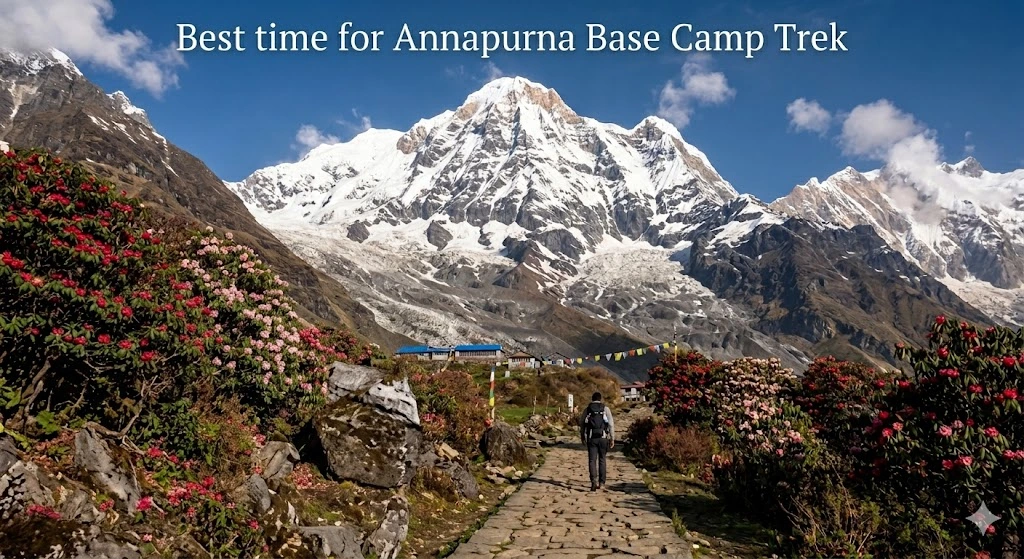
The biggest selling point of spring is the flowers. The lower elevations of the trek specifically between Ghorepani, Tadapani, and Chhomrong—are covered in dense, ancient rhododendron forests. In March and April, these trees burst into bloom. You will walk for hours through tunnels of bright red, pink, and white flowers. It is a completely different aesthetic compared to the dry, golden hills of autumn. If you are a nature lover or a macro photographer, spring is arguably better than autumn because the forest itself becomes the main attraction.
Temperatures and Weather Patterns
Spring starts off a bit chilly in March but warms up rapidly. By late April and May, the lower valleys can get quite hot and humid. Daytime temperatures at Nayapul and Tikhedhunga can reach 28°C (82°F), making the climb up the Ulleri stairs a very sweaty, exhausting affair.
The higher altitudes are much more comfortable. At ABC, daytime temperatures in spring are actually slightly warmer than in autumn, often reaching 10°C to 12°C (50°F to 54°F). Nighttime temperatures still drop below freezing, usually around -3°C to -5°C (26°F to 23°F), but it doesn’t feel quite as bone-chilling as November.
The one weather risk in spring is the pre-monsoon clouds. As May approaches, the moisture starts building up from the south. While it rarely rains heavily in May, the afternoons at ABC are often cloudy. You might wake up to a stunning sunrise, but by 10:00 AM, the peaks could be swallowed by white clouds. You just have to wake up earlier to guarantee your views.
The Downsides of Spring
Besides the afternoon clouds, the other major downside of spring is the dust. Because the winter winds have been blowing for months before you arrive, the trail especially around Nayapul and the lower valleys can be very dusty. You will find yourself covered in a fine layer of dirt by the end of the day.
The trail is also quite busy in spring, though usually slightly less crowded than the peak October weeks. The biggest issue in late April and May is the flight cancellations. As the heat builds up in the Pokhara valley, it creates heavy thermal winds. These hot winds create intense turbulence in the mountains, causing the small propeller planes to cancel flights frequently. If you are trekking in May, always build in two or three buffer days at the end of your trip just in case you cannot fly out of the mountains on time.
Who is Spring Best For?
Spring is ideal for trekkers who love lush green scenery, wildflowers, and slightly warmer temperatures at night. If you get cold easily and hate the idea of -10°C nights at base camp, April is a great compromise. It is also a fantastic time for wildlife spotting, as the forests are alive with birds and the rare Himalayan Langur monkeys.
Deep Dive: Summer/Monsoon (June, July, August & Early September) – The Wet Season
This is the season that most travel agencies actively tell you to avoid, and for very good reason. The summer months in Nepal are dictated by the Southwest Monsoon. This is a massive weather system that pulls moist air from the Indian Ocean and dumps it directly onto the Himalayas.
The Reality of the Rain
When it rains in the monsoon, it doesn’t just drizzle. It pours. It rains for hours, sometimes days, without stopping. The trail turns into a muddy, slippery mess. Those infamous stone steps that burn your thighs in autumn become extremely dangerous in July. A single slip on a wet, moss-covered step can result in a twisted ankle or a nasty fall that ends your trek immediately.
The lower sections of the trek, specifically around Tikhedhunga, Ulleri, and the bamboo forests, become a nightmare because of leeches. The ground is so wet and saturated that thousands of tiny leeches line the trail. They will crawl onto your boots and somehow find their way through your socks to attach to your skin. While they are harmless and don’t carry diseases, it is a deeply unpleasant experience that requires constant vigilance and salt sprays to keep them away.
The Clouds and Visibility
The most heartbreaking part of a monsoon trek is the lack of views. The entire Annapurna range is shrouded in thick, white clouds and mist. You can hike for 7 days, endure the rain, the mud, and the leeches, finally arrive at Annapurna Base Camp, and see absolutely nothing. The giant walls of ice and rock are completely hidden. You might catch a 10-minute glimpse of a peak before the clouds swallow it again, but that is the best you can hope for.
Are There Any Pros to Monsoon Trekking?
Surprisingly, yes. If you are a hardcore introvert who hates crowds, the monsoon is the quietest time on the trail. You will often have entire tea houses to yourself. The guides and porters are also much cheaper to hire, and you can negotiate room rates down to almost nothing.
The scenery is also incredibly vibrant. Nepal is an agricultural country, and the monsoon is the growing season. The terraced hills around Pokhara and Nayapul are a brilliant, emerald green. The waterfalls are roaring at their maximum capacity, and the rivers are raging. It is a beautiful, dramatic landscape, just not a mountain landscape.
Who is Monsoon Best For?
Honestly, only highly experienced trekkers who have already seen the mountains in clear weather, or people who have absolutely no other choice but to travel during the summer months. If you are a beginner doing your first Himalayan trek, do not come in the monsoon. The risk of injury on the slippery steps and the near-guarantee of no mountain views makes it a poor choice for a once-in-a-lifetime trip.
Deep Dive: Winter (December, January & February) – The Frozen Challenge
Winter in the Himalayas is not for the faint of heart. As the monsoon retreats in late autumn, the temperatures continue to drop until they hit their absolute lowest point in January. The sky is incredibly clear often clearer than autumn but the cold is brutal.
The Extreme Cold
To understand winter on this trail, you have to understand how cold -15°C to -20°C (5°F to -4°F) actually feels when you are sleeping in an unheated tin room. At base camp in January, the inside of your tea house is the exact same temperature as the outside. You will sleep wearing all of your clothes: your thermal base layers, your fleece, your down jacket, your wool hat, and your gloves inside your sleeping bag. If your sleeping bag is not rated for extreme cold, you will not sleep at all.
The water pipes in the tea houses freeze solid. There is no running water, which means the toilets become absolutely unusable and foul-smelling frozen blocks. Even during the day, the temperature at ABC might only reach 0°C (32°F) in the direct sun. The moment the sun sets at 4:00 PM, the cold becomes aggressive and painful on any exposed skin.
Trail Closures and Snow
The lower parts of the trail, from Pokhara to Chhomrong, are completely fine in winter. In fact, walking through Tikhedhunga and Bamboo in January is quite pleasant because the sun is warm and the air is dry.
The danger starts above Bamboo. Deep snow can bury the trail, especially around Deurali and Machapuchare Base Camp. Without footprints to follow, the trail becomes invisible, and there is a real risk of falling into a hidden crevasse near the glacier. Because of this danger, the Annapurna Conservation Area Project (ACAP) sometimes officially restricts access to the upper sanctuary in January and February if the snow is too deep. Even if it is open, many tea houses at ABC completely shut down because the owners descend to lower villages to wait out the winter. If you do go, you must bring a four-season tent and your own cooking gear just in case.
The Positives of Winter
Despite the misery, winter has one massive advantage: total solitude. You will have the entire Annapurna Sanctuary to yourself. There is no noise, no crowds, and no waiting in line for the bathroom. The photography is also out of this world. Because the air is so cold and devoid of moisture, the visibility is razor-sharp. The snow-covered peaks look incredibly stark and beautiful against the deep blue winter sky.
Who is Winter Best For?
Winter is only for highly experienced, self-sufficient alpine trekkers who have the proper extreme-cold gear (like a -20°C sleeping bag, expedition down suit, and crampons). If you are a beginner looking for a nice holiday, stay far away from the Himalayas in January.
The Ultimate Month-by-Month Breakdown
If you are still staring at your calender trying to cross out dates, here is a quick, brutally honest summary of every single month of the year:
January: Freezing cold, high risk of deep snow blocking the trail, many tea houses closed. Views are perfect, but the suffering is intense. Skip it unless you are a mountaineer.
February: Still very cold, but the days start getting slightly longer. The lower trail is nice, but ABC is still a frozen icebox. The tail end of February can be okay, but it is a gamble.
March: The magic begins. The rhododendrons start blooming in the lower forests. The temperatures at base camp are still cold at night, but very manageable. A fantastic time to go.
April: Peak spring. The forests are exploding with red flowers, the weather is stable and warm, and the trail is lively. Afternoon clouds might hide the peaks for a few hours, but mornings are gorgeous. Highly recommended.
May: Getting too hot in the valleys. The pre-monsoon clouds start rolling in heavily, and flight cancellations from Pokhara become a major headache. Only go in early May if you must.
June: The monsoon arrives. Rain starts falling heavily, the leeches come out, and the mountain views disappear. Do not attempt this trek in June.
July: The absolute worst month. Constant heavy rain, muddy dangerous trails, zero views, and high landslide risk. Avoid at all costs.
August: The rain is still relentless, though it might let up for a day or two. The leeches are everywhere. Still a terrible time to trek.
September: The transition month. Early September is still rainy, but by late September, the monsoon starts to retreat. The skies begin to clear, and the dust hasn’t settled yet. Late September can be a hidden gem if you time it perfectly.
October: The absolute best time for annapurna base camp trek. Perfect dry trails, zero clouds, comfortable temperatures, and the best mountain views on earth. It is crowded and expensive, but it is worth every penny.
November: Still incredibly beautiful, but the temperatures start dropping fast. By late November, the nights at ABC are brutally cold. Go in the first two weeks of November for the best balance of clear skies and tolerable cold.
December: Winter sets in. The lower trails are pleasant, but once you pass Bamboo, the deep freeze begins. Tea houses start closing down. Not recommended for casual trekkers.
How to Handle the Unpredictable Himalayan Weather
No matter what season you choose, you have to accept one fundamental truth: the mountains make their own rules. I have seen people go in late October the guaranteed best month and get hit by a freak two-day snowstorm that trapped them at Machapuchare Base Camp. I have also seen people go in late September and get a week of flawless, cloudless skies.Because weather apps are notoriously inaccurate in the high Himalayas (they might predict rain when it is sunny, or sun when it is snowing), you cannot stress over the forecast. The only way to handle the unpredictability is through your gear.
Always, always pack a high-quality waterproof rain shell, even in the dry autumn season. Pack a warm down jacket, even if you are going in the warm month of April. If you are caught in a sudden freezing hail storm at 3,500 meters, your fitness level won’t save you,only your layers will.When you wake up at 4:00 AM and it is pitch black and freezing cold, do not look at the clouds and get discouraged. The weather at ABC changes by the minute. A cloudy, miserable morning can turn into a blazing, sunny, perfect day by 8:00 AM. Keep walking, stay positive, and let the mountains surprise you.Explore more on our annapurna base camp trek guide.
Conclusion
Reaching the foot of the world’s tenth highest mountain is a deeply moving experience that completely strips away your daily worries and replaces them with raw wonder. The burning muscles, the chilly mornings, and the endless rugged stone steps all fade away the second you stand in the icy sanctuary, surrounded by towering peaks glowing in the golden sunrise. It is a beautiful test of physical endurance that humbles you and rewards you with profound peace. If you want to stand in that perfect mountain amphitheater, finding an affordable company for Annapurna Base Camp trek makes all the difference. Start planning your journey today, and let the clear skies welcome you.
FAQ
What are the absolute best months to trek to Annapurna Base Camp?
According to the blog, the best time is during the autumn months of October and November, closely followed by the spring months of March and April. These periods offer the most stable weather, crystal clear skies, and dry trail conditions, ensuring the best visibility of the mountain peaks.
What are the main downsides of trekking during the peak Autumn season?
The biggest downside to trekking in October and November is the crowds. Because the weather is perfect, the trails are busy, and popular tea houses in places like Ghorepani and ABC can fill up by early afternoon. Additionally, prices for rooms and food are significantly higher during this peak season.
How does altitude affect the temperature on the trek?
Temperature drops by approximately 6 degrees Celsius for every 1,000 meters you climb. While it may be a warm 25°C (77°F) in Pokhara, temperatures at Annapurna Base Camp (4,130m) can plummet to -5°C to -10°C (23°F to 14°F) at night, even during the best seasons.
Why is the Summer/Monsoon season (June to August) considered risky?
The monsoon brings heavy, relentless rain that turns the trails into a muddy and slippery mess, increasing the risk of injury. Furthermore, the thick clouds often completely obscure the mountain views, and the lower sections of the trail are infested with leeches.
Is it possible to trek during the Winter months?
Winter trekking is possible but only recommended for highly experienced, self-sufficient alpine trekkers. The temperatures are brutally cold (dropping as low as -20°C), deep snow can bury the trail near the base camp, and many tea houses close down for the season
What is the best way to handle unpredictable weather in the Himalayas?
Since weather apps are often inaccurate in the high mountains, the best strategy is to pack for all seasons. Regardless of the month, you should always carry a high-quality waterproof rain shell and a warm down jacket to handle sudden snowstorms or drastic temperature drops.


