
- 85 Views
- 17 Min Read
- (0) Comment
What if the best part of the Annapurna Circuit is not reaching the final destination, but stopping at the right place to watch the mountains? The trail takes you through green valleys, traditional villages, high mountain landscapes, and the dry Mustang region. Along the way, you get changing views of Annapurna, Dhaulagiri, Gangapurna, Tilicho Peak, and other Himalayan peaks.
In this blog, we explore the best viewpoints on Annapurna Circuit Trek, including scenic mountain stops, sunrise locations, photography spots, and high-altitude viewpoints. You will also learn the approximate altitude of these places, what you can see from each location, and how to make the most of the views during your trek.
The best viewpoints on Annapurna Circuit Trek include Upper Pisang, Ghyaru, Ngawal, Manang, Thorong La Pass, Muktinath, and Marpha. Each location offers a different perspective of the Himalayan landscape, from close Annapurna views and wide mountain panoramas to Dhaulagiri and traditional Himalayan villages.The beauty of the Circuit is that there is not just one viewpoint to visit. The scenery keeps changing as you gain altitude and cross different landscapes. This makes the entire trek a journey through changing mountain views rather than a route focused on one destination.
| Viewpoint | Approx. Altitude | Main Views | Best Feature |
| Chame | 2,710 m | Annapurna II and surrounding peaks | Forest and mountain scenery |
| Upper Pisang | 3,300 m | Annapurna II, Annapurna IV and surrounding peaks | Dramatic mountain backdrop |
| Ghyaru | 3,670 m | Annapurna II, III and IV | Wide panoramic views |
| Ngawal | 3,660 m | Annapurna range and Marsyangdi Valley | Village and mountain views |
| Manang | 3,540 m | Annapurna II, III, Gangapurna and surrounding peaks | Mountain village scenery |
| Yak Kharka | 4,050 m | Annapurna range and high slopes | High-altitude landscape |
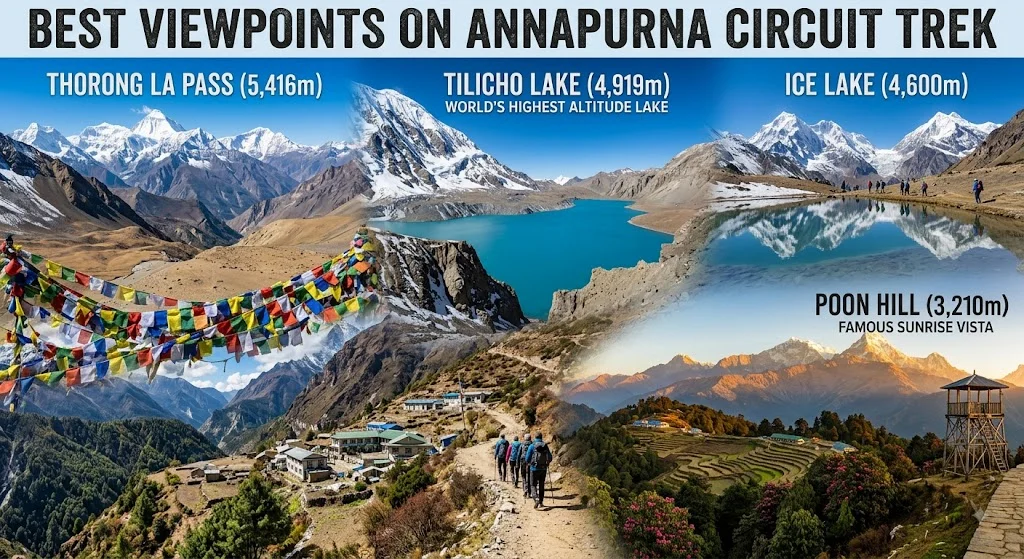
| Thorong La Pass | 5,416 m | Annapurna, Dhaulagiri and surrounding Himalayan landscape | Highest point on the Circuit |
| Muktinath | Around 3,800 m | Dhaulagiri and Mustang landscape | Mountain and cultural scenery |
| Marpha | Around 2,670 m | Dhaulagiri and Kali Gandaki Valley | Village and mountain scenery |
Where Can You See the Annapurna Mountains Best on the Circuit?
Upper Pisang, Ghyaru, Ngawal, and Manang are some of the best places to enjoy views of the Annapurna range. These locations provide different perspectives of the mountains, with some viewpoints looking across the valley and others offering closer views of the surrounding peaks.
The scenery becomes particularly impressive as you move higher into the Manang region. Traditional villages, steep mountain slopes, forests, and snow-covered peaks come together to create some of the most memorable sections of the trek.
Why Is Upper Pisang One of the Best Viewpoints?
Upper Pisang is one of the most rewarding stops for mountain views because the village sits above the Marsyangdi Valley. From the higher side of the settlement, you can enjoy dramatic views toward the Annapurna range while also seeing the surrounding valley and traditional houses.
The combination of mountain scenery and village architecture makes this area especially good for photography. Take some time to walk around rather than stopping at only one location. Different corners of the village can give you completely different views.
Why Is Ghyaru Famous for Mountain Views?
Ghyaru is famous for its elevated position above the Marsyangdi Valley and its broad views toward the Annapurna peaks. Reaching the village requires a steeper climb than the lower trail, but the extra effort gives you a different perspective of the surrounding mountains.
The view from Ghyaru is especially impressive because the valley appears far below while the high Himalayan peaks dominate the horizon. If the weather is clear, this is a good place to slow down, take photographs, and enjoy the landscape before continuing toward Ngawal and Manang.
What Can You See From Ngawal?
Ngawal offers wide views of the Annapurna range from a high settlement above the Marsyangdi Valley. The village itself adds another layer to the scenery, with traditional houses and mountain landscapes creating a strong combination for photography.
The view also shows how quickly the landscape changes with altitude. Lower sections of the valley appear greener, while the higher areas become dry and rugged. This contrast is one of the reasons Ngawal is worth including in your viewpoint stops.
Is Manang One of the Best Viewpoints on Annapurna Circuit?
Yes, Manang is one of the best places on the Circuit to combine mountain scenery with local Himalayan culture. At around 3,540 meters, the village sits in a broad mountain valley surrounded by impressive peaks and steep slopes.
Manang is also an important acclimatization stop. Instead of simply using it as a place to sleep, spend some time exploring the village and nearby areas. You can enjoy the mountain scenery without rushing into another long trekking day.
Which Mountains Can You See Around Manang?
The Manang region provides views of several peaks and mountain formations, including Annapurna II, Annapurna III, Gangapurna, and other surrounding Himalayan mountains. Exact visibility depends on weather, cloud cover, and your position along the trail.
Gangapurna is especially noticeable from the Manang area because of its impressive mountain face and glacier. Morning is often a good time to look toward the mountains before clouds become more common later in the day.
Why Should You Spend More Time Around Manang?
Manang is more than a stopping point before the trek toward Thorong La. It is an important place to adjust to the increasing altitude while enjoying one of the most scenic sections of the Annapurna region.
An extra night gives you time to walk around the village and explore nearby viewpoints. This slower pace can be useful for both acclimatization and photography, especially if the weather changes during the day.
Where Are the Best Sunrise Views on Annapurna Circuit?
Upper Pisang, Ghyaru, Ngawal, Manang, and several elevated sections of the trail can provide beautiful sunrise views when the weather is clear. Higher viewpoints with an open view toward the mountains are generally better because there are fewer trees or buildings blocking the horizon.
Early morning is also useful for photography because the light is softer and the mountain peaks can appear warmer as sunlight reaches them. However, sunrise quality depends heavily on clouds, weather, season, and your exact location.
Is Early Morning the Best Time for Annapurna Photography?
Early morning is usually one of the best times for mountain photography on the Annapurna Circuit. The light is softer, the mountains can be clearer, and there is often less harsh contrast than during the middle of the day. If you are planning a trip to the region, it is also helpful to check the best time for annapurna base campto ensure you experience similar ideal conditions for your photography.
You do not need expensive equipment to take good photographs. A smartphone can work very well in good light. Choosing a clear viewpoint and being ready when the light changes is often more important than having a large camera.
Which Viewpoint Is Best for Photography on Annapurna Circuit?
Ghyaru, Upper Pisang, Ngawal, Manang, Thorong La Pass, Muktinath, and Marpha are excellent photography areas because they offer different combinations of mountains, valleys, villages, and changing landscapes. There is no single viewpoint that is best for every type of photograph.
If you want close mountain views, focus on the Manang region. For high-altitude landscapes, Thorong La is hard to beat. For village and mountain photographs, Upper Pisang, Ngawal, and Marpha provide a more balanced scene.
| Location | Best Photography Subject | Recommended Time |
| Upper Pisang | Annapurna peaks and traditional village | Morning |
| Ghyaru | Wide mountain panorama | Early morning |
| Ngawal | Village and Annapurna range | Morning |
| Manang | Gangapurna and mountain valley | Morning |
| Yak Kharka | High-altitude landscape | Morning |
| Thorong La | High Himalayan panorama | Morning |
| Muktinath | Mustang landscape and mountains | Morning or afternoon |
| Marpha | Dhaulagiri and traditional village | Morning |
What Camera Gear Should You Carry?
A smartphone is enough for most trekkers who want to record their journey. If photography is one of your main reasons for trekking, a lightweight mirrorless or DSLR camera with one versatile lens can give you more control without making your backpack too heavy.
A small tripod can be useful for sunrise or low-light photographs, but it is not essential. Extra batteries, memory cards, and a power bank are often more useful on a long trek. Keep your equipment simple enough that you will actually carry it every day.
What Is the Highest Viewpoint on Annapurna Circuit Trek?
Thorong La Pass is the highest point of the Annapurna Circuit Trek at approximately 5,416 meters above sea level. The pass provides a dramatic high-altitude landscape, but reaching it requires a long ascent and careful attention to altitude, weather, cold, and trail conditions.
The landscape around Thorong La is very different from the lower sections of the Circuit. Forests disappear and the surroundings become rocky, dry, open, and exposed, creating a completely different type of Himalayan view.
What Can You See From Thorong La Pass?
Thorong La provides a wide view across the high Himalayan landscape, with the surrounding Annapurna and Dhaulagiri regions visible depending on weather and visibility. Prayer flags around the pass also create a distinctive Himalayan scene.
Do not plan to spend a very long time at the pass only for photographs. The altitude, wind, and cold can make the conditions uncomfortable. Take your photographs, enjoy the achievement, and begin your descent when conditions are suitable.
Can You See Dhaulagiri From Annapurna Circuit?
Yes, Dhaulagiri can be seen from several sections of the Annapurna Circuit, particularly after crossing toward the Mustang side and around the Kali Gandaki Valley. As the route moves westward, Dhaulagiri becomes an important part of the mountain scenery.
The mountain is especially impressive because of its huge size and snow-covered appearance. Clear mornings usually provide better opportunities for viewing distant peaks, so keep an eye on the weather rather than waiting for a specific named viewpoint.
Where Is the Best Place to See Dhaulagiri?
Muktinath, Marpha, and different sections of the Kali Gandaki Valley provide good opportunities to see Dhaulagiri. The view changes as you move through the valley, so there is no need to wait for one specific photo stop.
Marpha is particularly attractive because Dhaulagiri can be combined with traditional village scenery. Whitewashed houses, stone streets, orchards, and the surrounding mountains create a very different photographic experience from the high-altitude sections.
Which Viewpoints Offer the Best Mountain and Village Combination?
Upper Pisang, Ghyaru, Ngawal, Manang, and Marpha are excellent choices if you want photographs that include both mountains and traditional Himalayan settlements. These locations allow you to capture the landscape and local character of the region in the same frame.
The Annapurna Circuit is particularly good for this type of photography because villages are closely connected with the mountain environment. Stone houses, prayer flags, narrow trails, fields, monasteries, and snow-covered peaks often appear together.
Why Is Marpha a Good Photography Stop?
Marpha is known for its traditional whitewashed houses, stone-paved streets, and surrounding mountain landscape. After the higher sections of the trek, the village offers a quieter place to enjoy photography and explore local architecture.
The combination of traditional buildings, the Kali Gandaki Valley, and mountain views makes Marpha especially useful for cultural photography. It is a good reminder that the Annapurna Circuit is about villages and landscapes as much as it is about high peaks.
What Is the Annapurna Circuit Altitude Profile?
The Annapurna Circuitgains altitude gradually from the lower valleys before reaching its highest point at Thorong La Pass. Understanding the altitude profile is important because the main challenge is not only reaching a high elevation, but allowing your body enough time to adjust as you climb.
The exact altitude profile can vary depending on the route and transportation used at the beginning and end of the trek. These major locations give a general picture of how the elevation changes across the Circuit.
| Location | Approx. Altitude |
| Chame | 2,710 m |
| Upper Pisang | 3,300 m |
| Ghyaru | 3,670 m |
| Ngawal | 3,660 m |
| Manang | 3,540 m |
| Yak Kharka | 4,050 m |
| Thorong Phedi | Around 4,450 m |
| Thorong La Pass | 5,416 m |
| Muktinath | Around 3,800 m |
| Marpha | Around 2,670 m |
The altitude profile also explains why the scenery changes so much. As you climb higher, forests become thinner, vegetation becomes sparse, and the landscape becomes increasingly dry and rocky.
When Is the Best Time to Stop for Views on Annapurna Circuit?
Early morning is generally a good time for clear mountain views and photography, while late afternoon can offer attractive light around villages and lower valleys. The best time can change depending on the location and weather.
Mountain weather is not always predictable. Clouds can build during the day and completely change a view that looked clear earlier. If the mountains are visible and the trail is safe, it is often better to stop and enjoy the view rather than assume it will still be there later.
| Time | What You May Experience |
| Early morning | Clearer mountain views and soft sunrise light |
| Late morning | Good visibility in some locations |
| Afternoon | Changing light and possible cloud cover |
| Late afternoon | Warm light around villages |
| Evening | Village scenery and changing mountain visibility |
How Can You Find the Best Viewpoints While Trekking?
The easiest way to find good viewpoints is to look beyond officially named attractions. Open sections of the trail, village edges, ridgelines, and high points can provide excellent views even when they are not marked as viewpoints on a map.
Local guides and teahouse owners can also point out places that are easy to miss. A good viewpoint usually has an open line of sight, an interesting foreground, and a safe place where you can stop without blocking the trail.
What Should You Look for in a Good Viewpoint?
Look for a combination of clear mountain visibility, interesting foreground scenery, safe ground, and enough space to stop comfortably. A viewpoint does not need a sign or a famous name to be worth visiting.
Good viewpoints often include:
- Clear views toward major peaks
- Open sections without trees blocking the mountains
- Traditional villages or prayer flags
- Wide valley views
- Interesting foreground scenery
- Good sunrise or sunset direction
- A safe place away from exposed edges
How Can You Make the Most of the Annapurna Circuit Viewpoints?
The best way to enjoy the viewpoints is to slow down instead of treating every stop as a quick photo opportunity. Take a few minutes to look at the landscape first, then photograph it from different angles. Sometimes the best view appears between two famous locations rather than at a planned stop.
Keep your schedule flexible when possible. If the clouds suddenly clear while you are walking, take the opportunity. The Annapurna Circuit is a long mountain journey, so there is no reason to rush past a beautiful view just because it was not included in your original plan.
What Are the Best Viewpoint Photography Tips?
Use natural elements to create depth in your photographs. A village, trail, person, prayer flag, or tree in the foreground can make the distant mountains look larger and give the photograph more context.
Do not take every photograph from the same height. Try changing your position, using a lower angle, or waiting for another trekker to enter the frame. A person in the photograph can also show the enormous scale of the Himalayan landscape.
Most importantly, keep your camera accessible. If it is buried deep inside your backpack, you may miss the short moments when the clouds move and the mountains suddenly appear.
What Are the Common Mistakes When Chasing Viewpoints?
The biggest mistake is rushing through the trek just to reach famous viewpoints. Mountain weather changes quickly, and a location that looks ordinary in the morning can become beautiful when the clouds move and sunlight reaches the peaks.
Another mistake is focusing too much on photography and ignoring altitude, weather, and trail conditions. A good photograph is never worth taking an unnecessary risk.
| Common Mistake | Better Approach |
| Rushing to viewpoints | Walk at a comfortable pace and allow time for stops. |
| Ignoring weather | Check conditions before high-altitude sections. |
| Standing in unsafe places | Choose stable ground away from exposed edges. |
| Carrying too much camera equipment | Use lightweight equipment that you can comfortably carry. |
| Waiting too long for perfect light | Photograph when conditions are already good. |
| Ignoring village scenery | Include local culture and architecture in your photographs. |
| Only visiting famous viewpoints | Watch for natural viewpoints throughout the trail. |
Is the Annapurna Circuit Worth It for Mountain Views?
Yes, the Annapurna Circuit is an excellent choice if mountain scenery is one of your main reasons for trekking in Nepal. The route offers far more than one famous viewpoint, taking you through forests, traditional villages, high valleys, mountain passes, and the dry landscapes of Mustang.
The main attraction is the variety. One section can take you through green forests while another brings you into a dry high-altitude landscape surrounded by enormous Himalayan peaks. This constant change keeps the scenery interesting throughout the trek.
How Is Annapurna Circuit Different From Annapurna Base Camp for Views?
Annapurna Circuit and Annapurna Base Campare different trekking experiences. The Circuit offers a wider variety of landscapes and viewpoints because it travels around the Annapurna region and crosses Thorong La, while Annapurna Base Camp focuses on reaching a mountain sanctuary surrounded by high peaks.
If you prefer changing landscapes, traditional villages, high passes, and long panoramic sections, the Circuit may suit you better. If your main goal is to stand inside a dramatic mountain amphitheater surrounded by peaks, Annapurna Base Camp offers a more focused mountain experience.
| Feature | Annapurna Circuit | Annapurna Base Camp |
| Main viewing experience | Changing landscapes and panoramic mountain views | Mountain sanctuary and close peak views |
| Highest point | Thorong La, about 5,416 m | About 4,130 m |
| Landscape variety | Very high | High |
| High-pass experience | Yes | No |
| Mustang landscape | Yes | No |
| Village scenery | Extensive | Extensive |
| Best for | Varied Himalayan landscapes and high-pass experience | Close views of the Annapurna massif |
What Are the Key Viewpoints to Remember on Annapurna Circuit?
If you do not want to remember a long list of viewpoints, focus on Upper Pisang, Ghyaru, Ngawal, Manang, Thorong La, Muktinath, and Marpha. Together, these locations cover many of the different landscapes that make the Annapurna Circuit special.
Upper Pisang and Ghyaru are strong choices for Annapurna views, Manang combines mountains with village life, Thorong La provides the highest viewpoint, and Muktinath and Marpha offer beautiful scenery around the Mustang and Dhaulagiri region.The best viewpoint, however, may not be the one you planned to visit. Keep your eyes open while walking because changing light, clouds, villages, and mountain landscapes can create memorable views anywhere along the trail.
Conclusion
The best viewpoints on Annapurna Circuit Trek are spread across the entire route rather than concentrated in one location. From Upper Pisang, Ghyaru, and Ngawal to Manang, Thorong La, Muktinath, and Marpha, each section offers a different perspective of the Himalayan landscape.
Early morning is usually a good time for clear mountain views and photography, while late afternoon can create beautiful light around villages and lower valleys. Weather controls what you see, so keeping your schedule flexible can make a big difference.
The Annapurna Circuit is not only about reaching Thorong La or checking famous viewpoints from a list. Some of the most beautiful moments can happen while walking between villages. Take your time, keep your camera ready, and leave enough space in your trek to stop whenever the mountains give you a reason to look back.
Frequently Asked Questions About Annapurna Circuit Viewpoints
What are the best viewpoints on Annapurna Circuit Trek?
Some of the best viewpoints include Upper Pisang, Ghyaru, Ngawal, Manang, Thorong La Pass, Muktinath, and Marpha. Each location offers a different perspective, from close Annapurna views and high-altitude panoramas to Dhaulagiri and traditional Himalayan villages.
Where can I see the best views of the Annapurna range?
Upper Pisang, Ghyaru, Ngawal, and Manang are among the best areas for views of the Annapurna range. Clear mornings often provide better visibility, especially before clouds develop around the mountains later in the day.
What is the highest viewpoint on Annapurna Circuit?
Thorong La Pass is the highest point of the Annapurna Circuit at approximately 5,416 meters. The pass provides a dramatic high-altitude landscape, but trekkers should not stay there for too long because of the cold, wind, and elevation.
Is Ghyaru worth visiting on Annapurna Circuit?
Yes, Ghyaru is worth visiting for its elevated position and wide mountain views. The climb is steeper than some other sections, but the village provides an excellent perspective over the Marsyangdi Valley and surrounding Annapurna peaks.
Where can I see Dhaulagiri on Annapurna Circuit?
Dhaulagiri can be seen from several areas on the western side of the Circuit, particularly around Muktinath, Marpha, and the Kali Gandaki Valley. Clear weather provides the best chance of seeing the mountain clearly.
What is the best time for photography on Annapurna Circuit?
Early morning is generally one of the best times for mountain photography because the light is softer and visibility can be clearer. Late afternoon can also produce attractive light, particularly around villages and lower mountain areas.
Is Annapurna Circuit good for photography?
Yes, the Annapurna Circuit is excellent for photography because the scenery changes from green valleys and forests to high-altitude landscapes, traditional villages, mountain passes, and dry Mustang terrain. You can capture both mountain and cultural photography throughout the trek.